
How to Search Fairfax County Court Records
The main tool for Circuit Court cases is Fairfax eCaseSearch. The county built it as a free public portal and launched it on July 1, 2024. It gives 24/7 access to non-confidential civil and criminal case index data for the Fairfax Circuit Court. Index information goes back to October 18, 2004. It does not provide documents, and it does not show sealed cases.
Have your details ready before you begin. A full case number is fastest. A name search needs at least the first two letters of the last name or company name. Each search returns up to 100 results at a time.
- Open Fairfax eCaseSearch and pick your language if needed.
- Select Civil or Criminal as the case type.
- Choose to search by party name or by case number.
- Enter the name or number, then run the search.
- Click a case number to read parties, status, and hearing dates.
The official portal interface is the Fairfax eCaseSearch public access system.
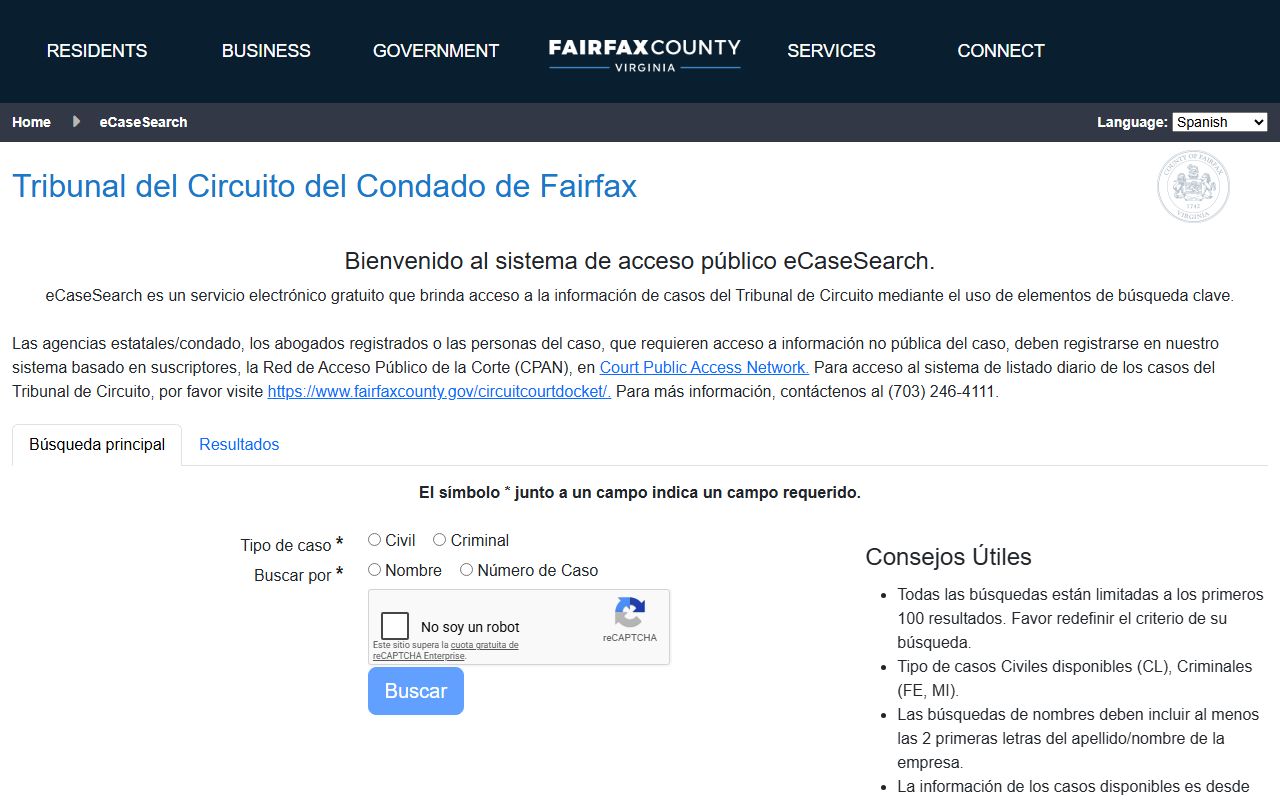
The portal is offered in several languages, including English, Spanish, Korean, Vietnamese, Arabic, Chinese, and Amharic, which helps a wide range of county residents.
Fairfax County Court Records Search Fields
eCaseSearch keeps the form short. You choose a case type, pick how to search, then enter your terms. A star marks any required field. The table below lists the main fields and how they work.
| Field Label | Type | Required | Notes / Format |
|---|---|---|---|
| Case Type | Radio | Yes | Civil (CL) or Criminal (FE, MI). |
| Search By | Radio | Yes | Party Name or Case Number. |
| Case Number | Text | If searching by number | Enter the exact case number. |
| Last Name / Company | Text | If searching by name | At least the first two letters. |
| First Name | Text | No | Narrows a party-name search. |
| Language | Selector | No | Seven languages offered. |
Each result links to a case detail page, but the index does not include downloadable documents.
General District Court Online Case Information
Traffic, misdemeanor, small claims, and limited civil cases are not in eCaseSearch. They sit in the Virginia General District Court Online Case Information system, reached from the state Judicial System case page. Fairfax General District Court policy says you select either Fairfax County or Fairfax City General District Court, then search. With a full case number, you type the number and run the search. Name and hearing-date searches are also supported.
The statewide case-status landing page is the Virginia Judicial System case information home.
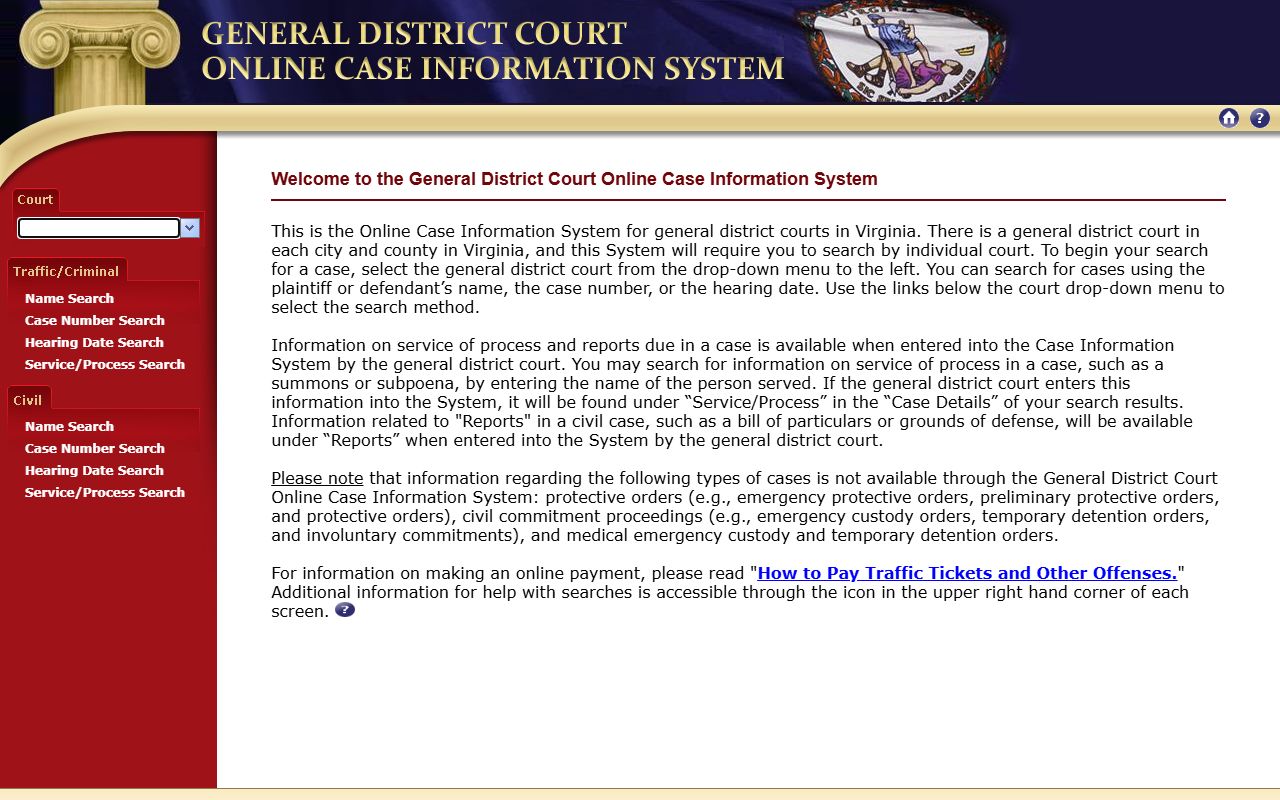
You must pick the right court from the menu, since Fairfax County and Fairfax City run separate General District dockets.
The same state portal also hosts the case-status home that ties the district, juvenile, and circuit search options together, shown on the Virginia case information page.
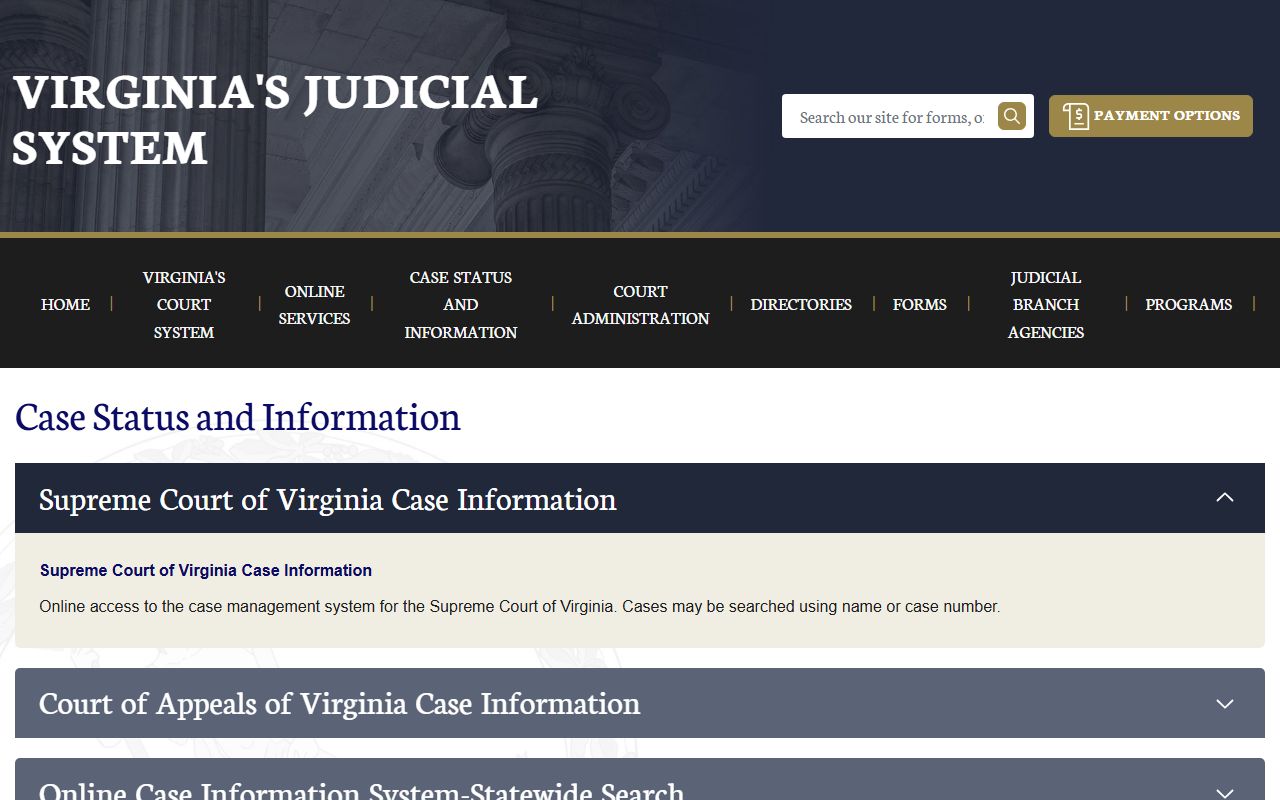
From there you choose the court type first, which keeps a Fairfax County General District search separate from a circuit or juvenile lookup.
One key quirk: the statewide Circuit Court case system does not include Fairfax. The state page lists Fairfax only to say it does not take part and to send users to eCaseSearch or to 703-246-4111. The Virginia Judicial System Self-Help site also explains how to find a case by court level.
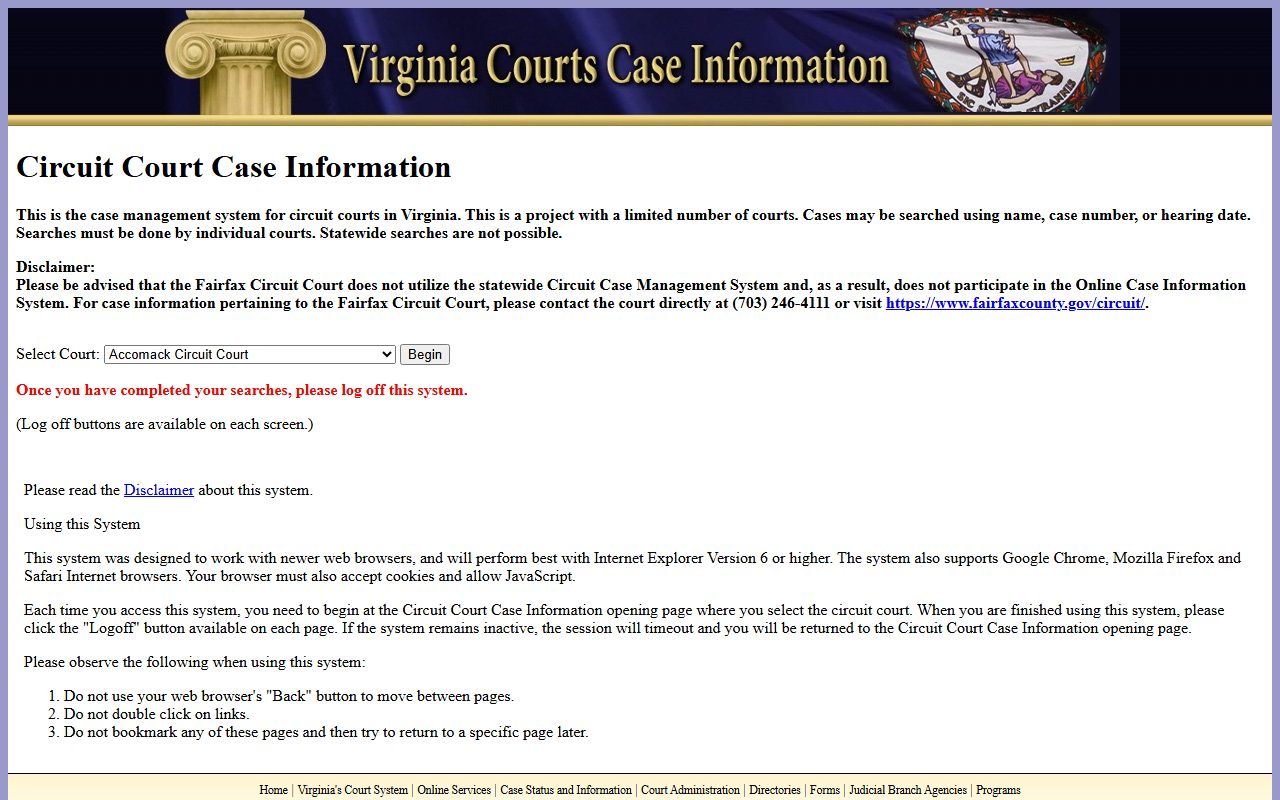
Because of that gap, a person who searches only the statewide circuit system may wrongly think a Fairfax Circuit case does not exist.
Types of Fairfax County Court Records
Court records here split by case type and by court. Circuit Court holds the largest civil and criminal files. The district courts hold traffic, misdemeanor, small claims, and limited civil matters. Family and probate files follow their own rules. The court that hears a case keeps that record.
The main groups look like this.
- Civil Circuit records: complaints, motions, orders, and judgments above the district limit.
- Criminal Circuit records: felony indictments, plea and sentencing orders, and appeals from district court.
- General District records: civil warrants, small claims, unlawful detainers, misdemeanors, and traffic.
- Family and divorce records: divorce decrees in Circuit Court; custody and support often in JDR.
- Probate and land records: wills, estates, deeds, and related instruments kept by the clerk.
For docket and hearing schedules, see the Fairfax County court dockets page.
What Fairfax County Court Records Show
A public case record holds the basic facts of the case, not the full file. The court's subscription system lists fields such as case number, date filed, status, parties, attorneys, hearing information, and payment history. The table below shows what a typical case detail returns.
| Field | What It Shows |
|---|---|
| Case Number | The court ID, often with a CL, FE, or MI code. |
| Filing Date | When the case began or a paper was filed. |
| Parties | Plaintiff and defendant, or Commonwealth and defendant. |
| Attorneys | Counsel of record where public. |
| Hearings | Date, time, and docket type. |
| Disposition | The final outcome of the case or charge. |
Documents are not part of the free index. Official copies come through the clerk or, for eligible users, the subscriber Court Public Access Network.
Public Access Framework for Fairfax County Court Records
Court records follow their own access path, not the ordinary county FOIA route. Fairfax Circuit Court notes that records kept by clerks of courts of record are exempt from FOIA because they are already open under Virginia Code § 17.1-208. So the right channel for court records is the clerk, the online systems, or a copy request.
Online display of sensitive data is limited by law. Virginia Code § 17.1-293 restricts how Social Security numbers and other identifiers appear in remote systems. That is one reason the public index shows case data but not full documents.
Note: Court records are not handled as a standard FOIA request; use the clerk, the online case systems, or the copy process to get Fairfax County court records.
Records That Are Sealed or Confidential in Fairfax County
Some files stay closed. Adoption files are sealed, and an inactive adoption file needs a court order to view. Juvenile and JDR records are confidential under state law. Sealed and expunged criminal cases do not appear in the public index, since eCaseSearch states sealed cases are not provided. Mental health commitment records are also confidential.
To reach a sealed record, you generally file a motion or petition in the court that controls it. Expungement under Virginia Code § 19.2-392.2 can remove eligible records from ordinary public access. A clerk cannot simply hand over a sealed file without that authority.
Copy Requests and Older Files
Records here are stored by age and type. More current criminal files are in the Criminal Division on the fourth floor. Civil file review and copies run through the Civil Records office on the third floor. Recent probate files go through the Probate Department. Older civil, chancery, fiduciary, and criminal files may sit at the Offsite Records Center in Merrifield. Historic materials are at the Historic Records Center.
For a mailed copy, include the case number or year of order, full party names, a certified check or money order payable to the Clerk of the Fairfax Circuit Court, and a self-addressed stamped envelope. Personal checks are not accepted. The clerk's records page lists the divisions and request rules.
The official records instructions appear on the Circuit Court records page.
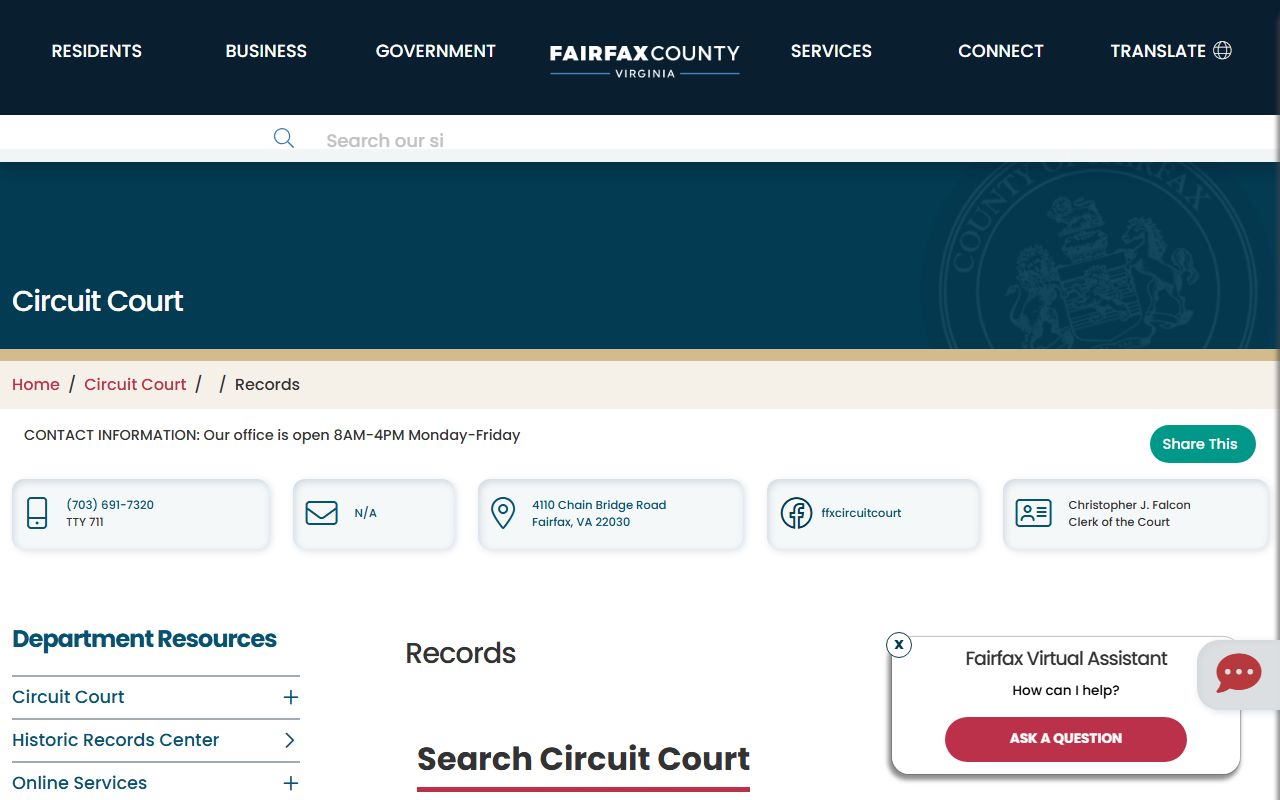
That page also explains the online File Review Request Form, which lets you ask to review a civil file without a counter visit.
If you are not sure which court or system to use, the state self-help site walks through how to find a case step by step.
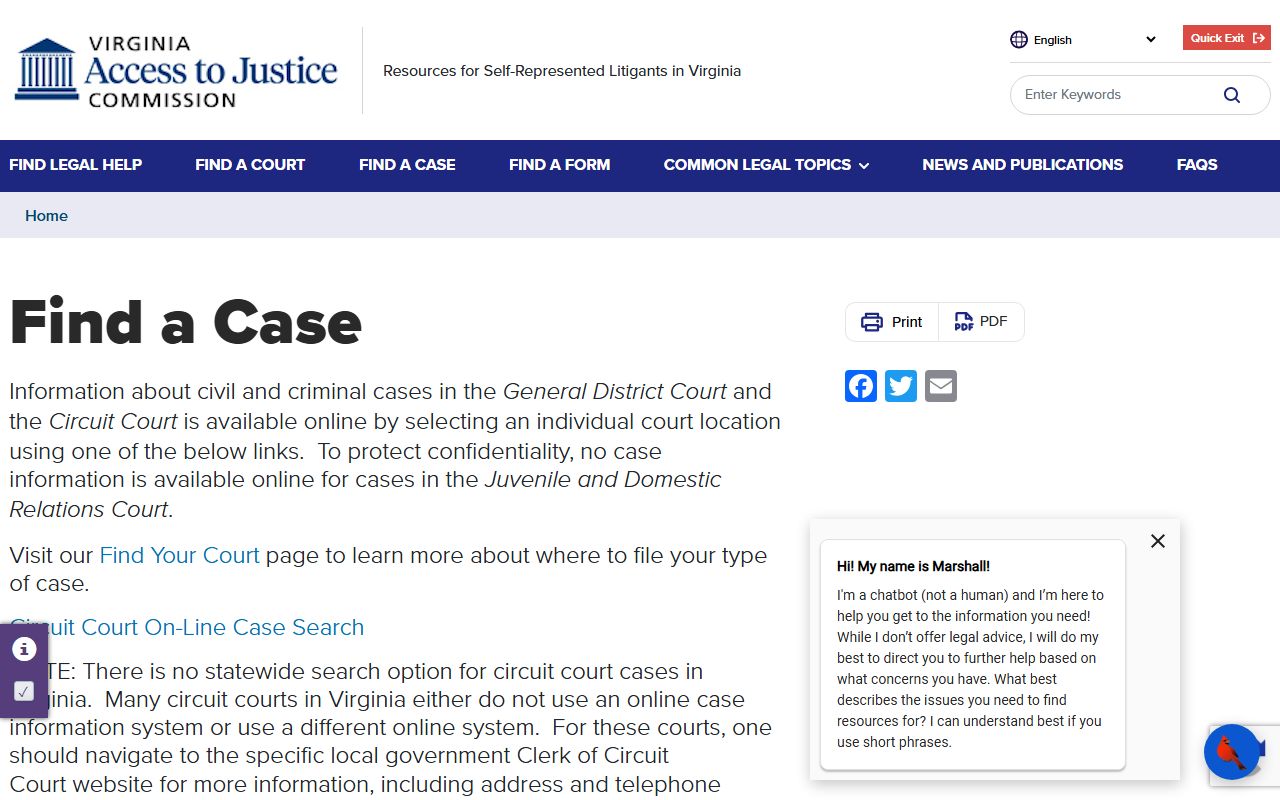
It is a good first stop when you have a name but no case number and do not know the court level.
In-Person Court Record Requests
You can review and copy many records at the courthouse during business hours. Bring identifying details and a payment method that the clerk accepts. The main records counters are in the Judicial Center.
Clerk of the Fairfax Circuit Court
4110 Chain Bridge Road, Suite 320
Fairfax, VA 22030
703-691-7320
Mon-Fri 8:00 a.m. to 4:00 p.m.