
How to Search Fairfax County Probate Records
Probate records are kept by the Clerk of the Circuit Court. For recent probate files and copies, you contact the Probate Department at 703-246-4153. The department can confirm what is required to qualify an estate or to request a copy. There is no standalone public probate search portal like the case index, so the phone and the copy-request process do the work.
If a probate matter is part of a Circuit Court case file and you know the page count, you can mail a request to the File Room. Include the case number or year of order, full party names, a certified check or money order, and a self-addressed stamped envelope. For general case-index searches, see the Fairfax County court records page.
Circuit Court Probate Department
4110 Chain Bridge Road
Fairfax, VA 22030
703-246-4153
Mon-Fri 8:00 a.m. to 4:00 p.m.
Offsite Records Center
2730 Prosperity Avenue, Suite 100
Merrifield, VA 22031
703-246-6656
Older fiduciary files
Probate in the Circuit Court, Not a Separate Court
Virginia does not give Fairfax a standalone probate court. The Circuit Court Clerk handles routine probate and fiduciary work at the counter. A contested matter, however, is different. A will contest, a fiduciary dispute, a guardianship fight, or a suit over estate property becomes a Circuit Court case before a judge.
So probate has two faces here. Routine qualification and probate of a will usually begin with the clerk or probate office. A real dispute moves to the Circuit Court's civil docket. That distinction explains why some estate matters are quick counter work and others turn into full litigation.
How Probate Works in Fairfax County
The process follows a fairly set order. Knowing the steps helps an executor or family member prepare for the first appointment.
- Determine whether the decedent had a will and whether Fairfax is the proper venue.
- Contact the Probate Department to schedule probate and confirm required documents.
- Bring a certified death certificate, the original will, heir information, and ID.
- Clerk staff set qualification documents, the oath, any bond, and certificates.
- Pay the probate and fiduciary fees under the current schedule.
- The personal representative gives notices, files an inventory, and later files accountings.
A contested will or trust dispute proceeds before the Circuit Court rather than at the probate counter.
What Probate Records Include
An estate file can hold many documents. The exact set depends on the estate and whether anyone contests it. Common probate records include the items below.
- The original will and any codicils, if admitted.
- The certificate of qualification for an executor or administrator.
- The fiduciary oath and any bond or security documents.
- A list of heirs or beneficiaries and an inventory of estate assets.
- Accountings, creditor notices, and closing documents where required.
Guardianship and conservatorship matters add their own orders and findings. The Circuit Court also handles trust and estate litigation when a dispute arises.
Probate Record Request Fields
A copy or file request needs enough detail for staff to find the record. The table below shows what the probate office and File Room look for.
| Field Label | Type | Required | Notes / Format |
|---|---|---|---|
| Decedent name | Text | Yes | Needed for a file request or probate appointment. |
| Date of death | Date | Yes | Needed to schedule probate. |
| Case or file number | Text | If known | Speeds a copy request. |
| Year of order | Date | If no case number | Used to locate copies. |
| Payment | Money order | Yes for mail | Certified check or money order to the clerk. |
The clerk does not accept personal checks by mail, and a self-addressed stamped envelope should be included.
Probate and Fiduciary Fees
Probate fees are not one flat number. They follow the Circuit Court fiduciary and probate fee schedule, and the total depends on several factors. The table below shows what drives the cost rather than a single price.
| Fee Item | Basis |
|---|---|
| Probate tax | Based on the value of the estate. |
| Qualification | Set by the fiduciary and probate fee schedule. |
| Certificates of qualification | Per certificate, per the schedule. |
| Copies | Per the clerk's copy fees. |
Because the amounts change by statute and estate value, the current fiduciary and probate fee schedule is the right reference. The Clerk of Court page covers the broader fee picture.
Probate Terms Glossary
Estate work uses words that confuse many families. A few short definitions help.
- Testator
- A person who makes a will.
- Executor
- The person named in a will to carry out the estate.
- Administrator
- A person appointed to settle an estate when there is no executor.
- Intestate
- Dying without a valid will.
- Fiduciary
- A person appointed to manage an estate, trust, or guardianship.
- Conservator
- A person appointed to manage the finances of someone who cannot.
Older Fiduciary and Historic Probate Files
Not all probate files sit at one counter. Recent files are with the Probate Department. Older civil, chancery, fiduciary, and criminal files may be at the Offsite Records Center in Merrifield. Historic probate-related material is at the Historic Records Center on the third floor of the courthouse, Suite 317, reached at 703-246-4168.
For older files, you may need to submit a file review request rather than walking to a single window. The Historic Records Center preserves early court records, including deed books that run from 1742 to 1942. For broader access rules, see the Fairfax County public records page.
Guardianship, Conservatorship, and Contested Estates
Some matters go well beyond a simple will. A guardianship gives someone authority over an incapacitated person's care, while a conservatorship covers finances. These cases can involve sensitive medical and capacity evidence, and access may differ from ordinary estate administration.
A contested will, a fight over who serves as fiduciary, or a trust dispute is handled by the Circuit Court as a civil case. That means it can generate a docket you can track through the court systems, unlike routine counter probate. A clerk can give procedural and copy information but cannot give legal advice about estate administration.
Restricted and Confidential Probate Materials
Estate files are mostly open, but parts can be restricted. Some fiduciary records include personal identifiers, financial account references, medical or capacity evidence, minor information, or sealed attachments. Those pieces may be limited even when the rest of the file is public.
Estate matters also touch related records that Virginia protects on their own. Marriage records, for example, carry their own confidentiality rules, which can matter when an estate involves a surviving spouse.
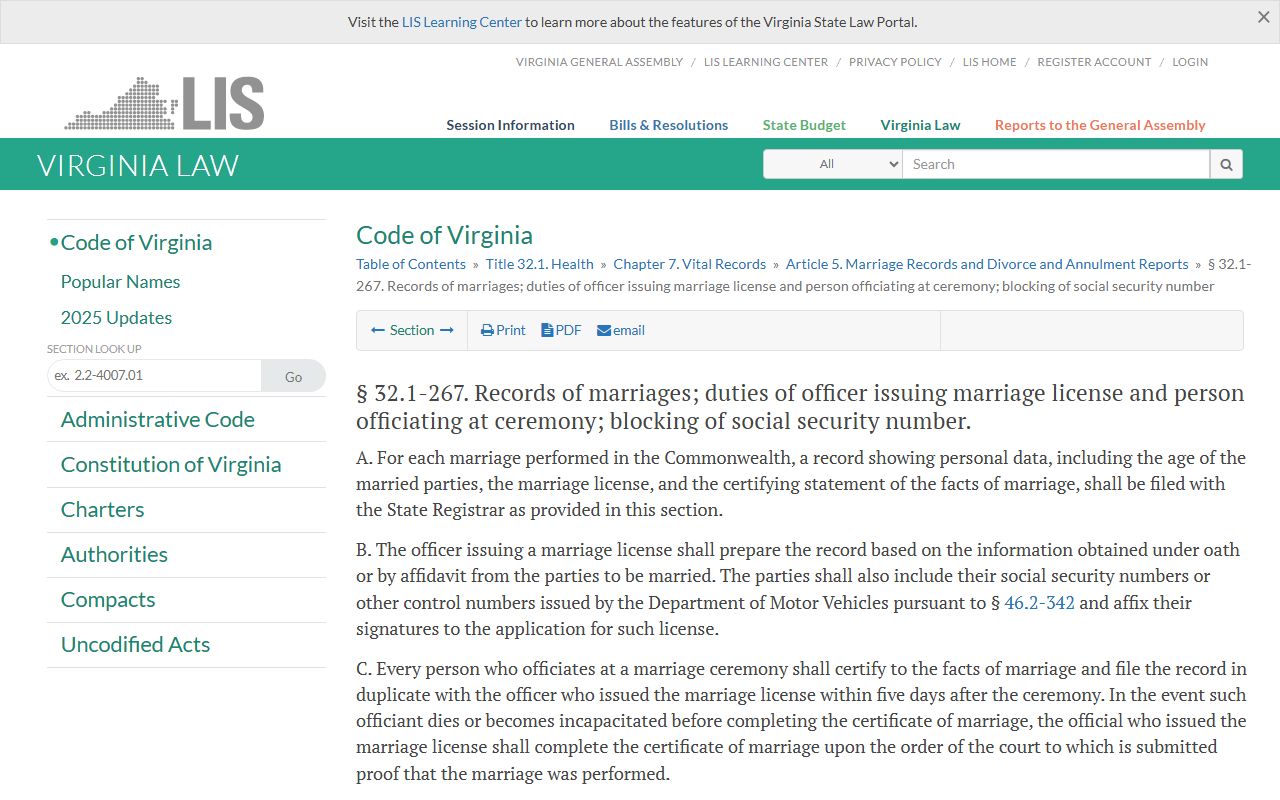
That marriage-record protection comes from Virginia Code § 32.1-267, and the marriage and divorce records page covers it in full.