
Fairfax County District Courts Overview
Virginia uses two district courts at the local level. The General District Court takes traffic, misdemeanor, civil, small claims, and preliminary felony matters. The Juvenile and Domestic Relations District Court, or JDR Court, handles juvenile delinquency and family cases. Both sit in the 19th Judicial District and below the Circuit Court.
A case can flow through several levels. The path runs Magistrate, then General District Court, then Circuit Court on appeal, then the appellate courts. The state court-system page lists the Fairfax General District Court judges and schedule.
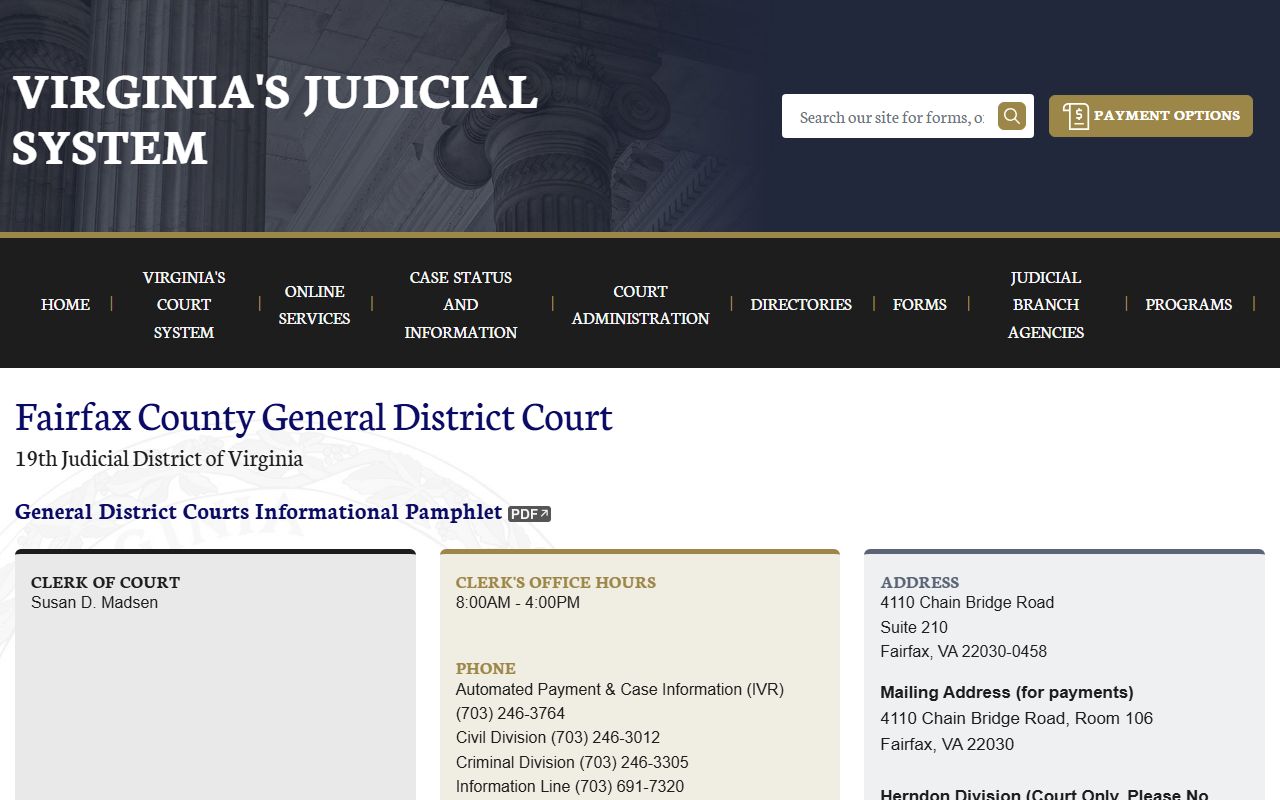
The official state Fairfax General District Court page carries the judge list and the daily docket schedule.
General District Court Jurisdiction
The General District Court hears a wide mix of cases, all decided by a judge rather than a jury. It takes traffic violations, misdemeanors, and preliminary hearings in felony cases. On the civil side, it handles claims up to a set dollar limit, landlord-tenant disputes, contract disputes, and personal injury actions.
Small claims are a special track. Those are civil cases seeking money or property up to $5,000, and attorneys are not used in small claims court. Jury trials happen only in Circuit Court. The Fairfax County court dockets page lists the daily General District schedule.
Fairfax County District Court Locations
The main courts sit in the Judicial Center, with two General District Court division courtrooms elsewhere in the county. The table below lists the locations and phones.
| Court / Office | Type | Address | Phone |
|---|---|---|---|
| General District Court | Main | 4110 Chain Bridge Road, Suite 210, Fairfax | 703-246-3764 |
| Herndon Division | Court only | 765 Lynn Street, Herndon | Use main GDC contacts |
| Vienna Division | Court only | 127 Center Street South, Vienna | Use main GDC contacts |
| JDR District Court | Juvenile / family | 4110 Chain Bridge Road, Fairfax | 703-246-3367 |
| Juvenile Detention Center | Secure detention | 10650 Page Avenue, Fairfax | 703-246-2844 |
The Herndon and Vienna sites are courtrooms only and do not take mail, so filings and payments use the main General District Court.
Judges and Clerks
Each district court has its own clerk. Susan D. Madsen serves as Clerk of the General District Court, handling traffic, misdemeanor, civil, small claims, and landlord-tenant case processing. Kristi Smith serves as Clerk of the Juvenile and Domestic Relations District Court.
The clerks assign case numbers, schedule hearings, and keep the court files within the limits the law allows. The state court-system page lists the General District Court judges and the court schedule, which is useful when you need to confirm a hearing.
Civil Cases and Small Claims
Civil filing in the General District Court starts with the right form. Common civil pleadings include a warrant in debt, which seeks a money judgment, and a warrant in detinue, which seeks return of personal property. Unlawful detainer is the eviction case type.
The General District Court Civil Division page covers filing rules and forms.
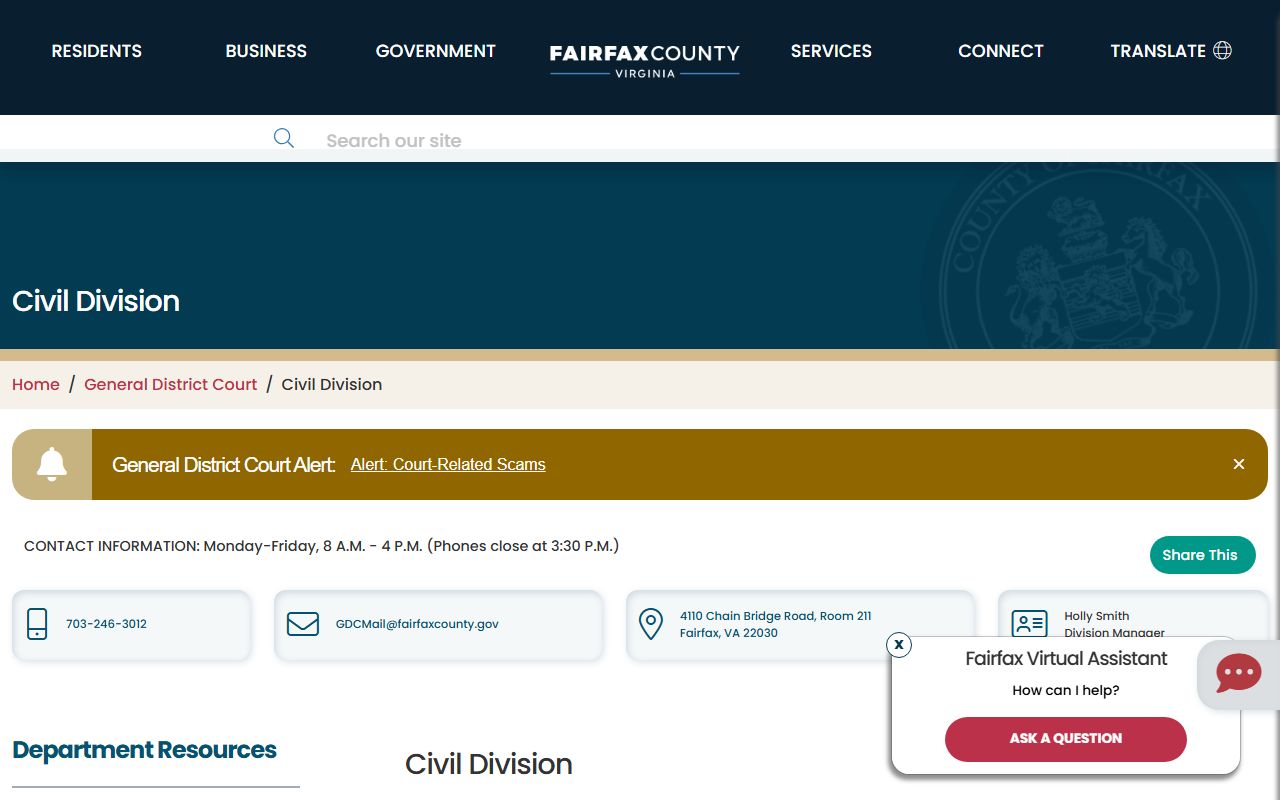
You can review civil rules on the General District Court Civil Division page.
Filing a civil action follows a set process, with the right paperwork and fees.
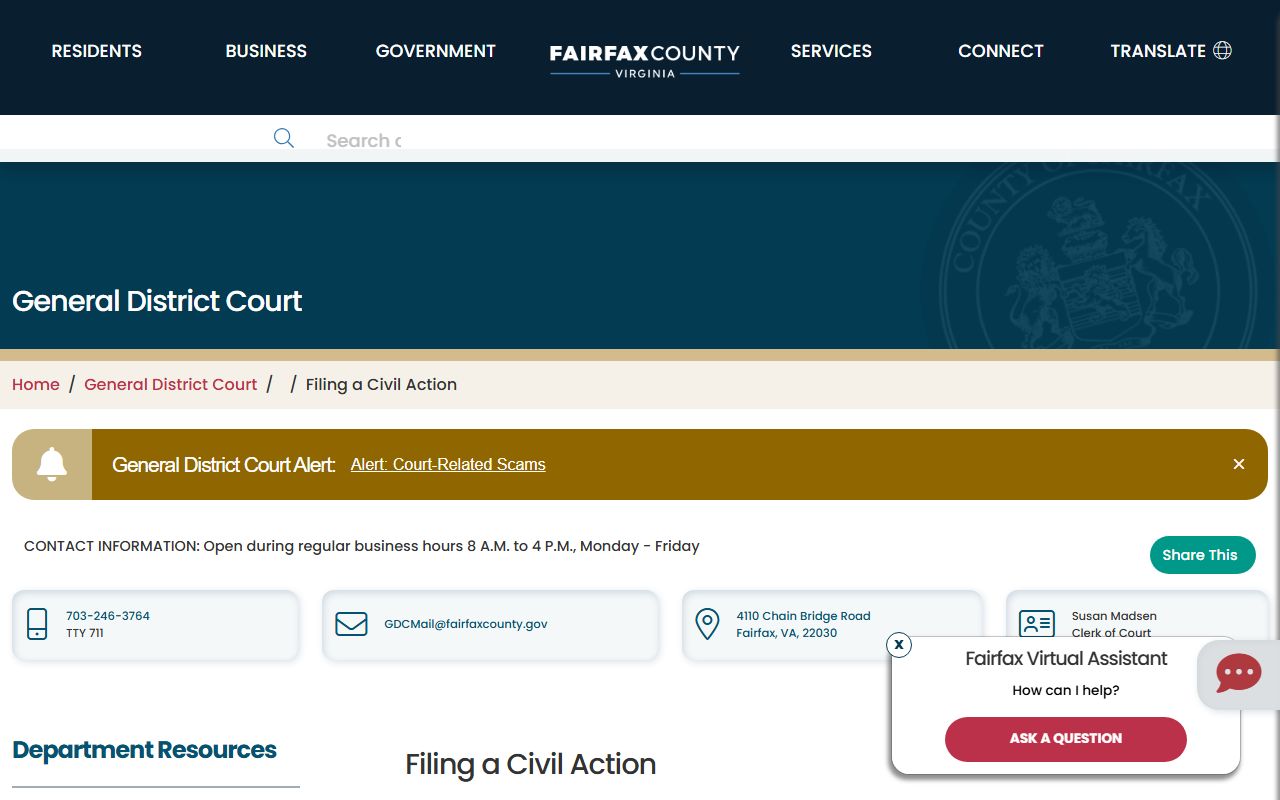
The steps for filing a civil action are posted by the court.
Traffic and Criminal Dockets
Traffic and criminal cases make up a large share of the General District Court's work. The court runs separate dockets for traffic, criminal, bond motions, and preliminary hearings. Most traffic offenses are infractions punishable by a fine, though some require a court appearance.
A conviction for certain offenses can trigger DMV points as a separate administrative action. The full traffic process, payment rules, and DMV-versus-court distinction are on the Fairfax County traffic court records page. For arrests and criminal case basics, see the arrest records page.
Appeals to Circuit Court
A district court is not the last word. A case decided in the General District Court can be appealed to the Circuit Court, where it gets a brand new trial called a trial de novo. Small claims and traffic appeals follow the same path.
Because the Circuit Court is a court of record and the district courts are not, the appeal starts the case over rather than just reviewing the lower decision. The Fairfax County court records page covers the Circuit Court case search.
There are deadlines to watch. An appeal must be noted within the time the law allows after the district court decision, and the case then moves to the Circuit Court docket. A person who wants to appeal should ask the district court clerk about the exact steps and timing, since missing the window can end the right to a new trial.
Juvenile and Domestic Relations District Court
The JDR Court is the family and juvenile side of the district courts. It handles juvenile delinquency, child custody and visitation, child support, family-abuse protective orders, and child welfare. Because these matters are sensitive, many JDR records are confidential under state law.
The court works through three parts: a Court Services Unit, a Clerk's Office, and the judges. Most cases begin with intake officers in the Court Services Unit, who help the public prepare documents for filing. That intake-first model is different from a simple online docket search.
Domestic Relations Services
Domestic Relations handles intake for custody, visitation, child support, spousal support, paternity, protective orders, and mediation. The office is in Suite 202 at the courthouse, reached at 703-246-3040. South County appointments are available on Wednesdays at a Richmond Highway location in Alexandria.
The intake page explains how custody and support cases begin.
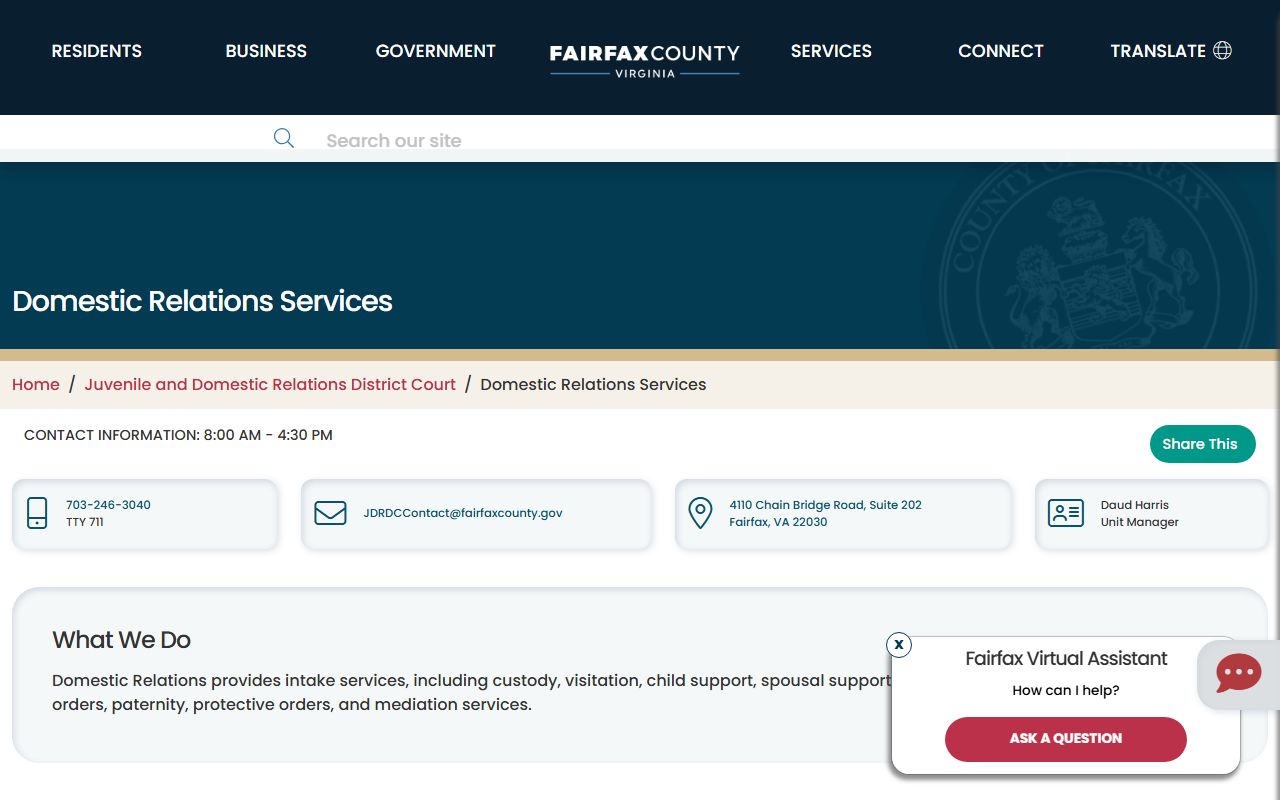
The Domestic Relations page notes that the party seeking custody generally must reside in Fairfax County unless there is a prior or pending Fairfax JDR order.
Specialty Dockets
The district court hosts several specialty dockets tied to the county's Diversion First work. The Veterans Treatment Docket serves justice-involved veterans dealing with addiction or mental illness, and Fairfax was the first jurisdiction in Virginia to organize this kind of program.
The Veterans Treatment Docket has its own official page.
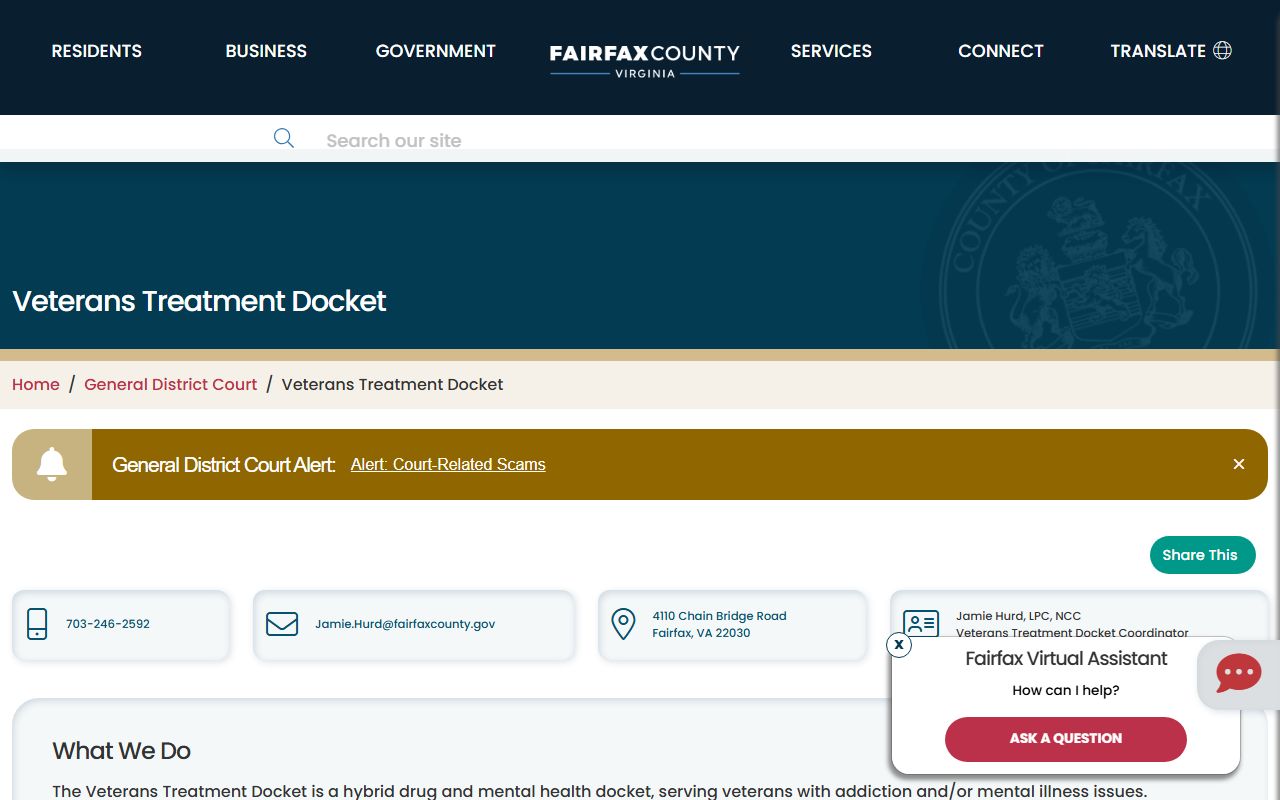
The Veterans Treatment Docket page describes eligibility and the program, and a Mental Health Docket meets on set days as well.
District Court vs Circuit Court
The two court levels do very different work. The comparison below shows the main differences.
| Feature | General District Court | Circuit Court |
|---|---|---|
| Jurisdiction | Limited | General, court of record |
| Civil claims | Up to the district limit; small claims to $5,000 | Above the district limit; over $50,000 exclusive |
| Jury trials | No | Yes, where available |
| Main case types | Traffic, misdemeanor, small claims, landlord-tenant | Felony, major civil, divorce, probate |
| Appeals | Appeal to Circuit Court for a new trial | Appeal to the Court of Appeals of Virginia |
For the Circuit Court clerk, land records, and probate, see the Clerk of Court page.