
How to Search Fairfax County Court Records
The search path depends on the court. Fairfax Circuit Court runs its own free portal called eCaseSearch, which went live July 1, 2024. It gives public access to non-confidential civil and criminal case index data for the court of record, with index information going back to October 18, 2004. It does not show documents, and it does not show sealed cases. For traffic and misdemeanor matters, you use a different system run by the state. Juvenile and most family cases are not open online at all.
Before you start, gather a few details. A full case number gives the fastest result. If you only have a name, you need at least the first two letters of the last name or company name. Pick the right court, or a real case may look like it does not exist.
- Open Fairfax eCaseSearch for Circuit Court civil and criminal index data.
- Choose Civil or Criminal, then search by party name or case number.
- For a traffic or misdemeanor case, switch to the Virginia General District Court Online Case Information system and select Fairfax County General District Court.
- Open the case to read parties, status, hearing dates, and docket activity.
- Request a certified copy from the Clerk's Office if you need an official document.
The official Fairfax Circuit Court home page links to eCaseSearch and many other court tools, as shown on the Circuit Court website.
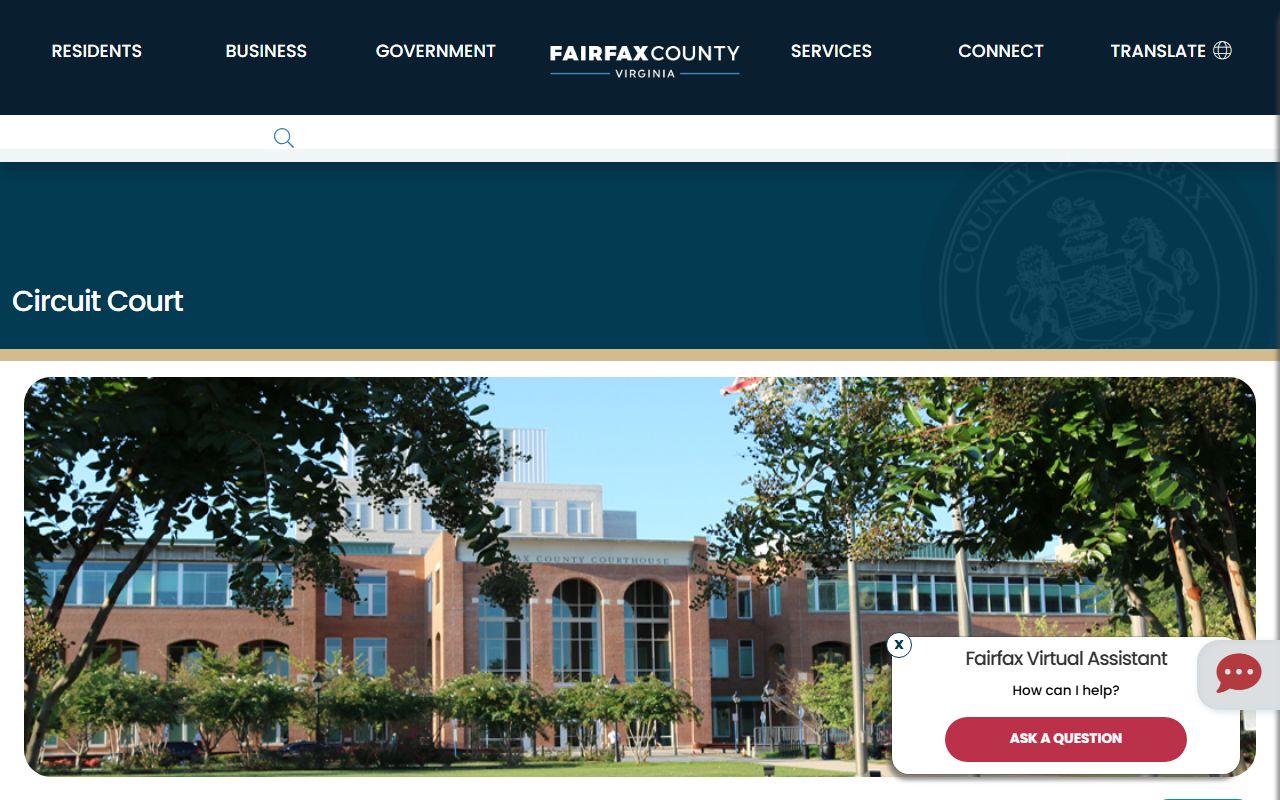
The Circuit Court page also points users to CPAN, electronic filing, online scheduling, and marriage pre-application links, so it works as a hub for most court records tasks.
The Fairfax County Judicial System
Virginia runs a unified court system, and Fairfax County sits in the 19th Judicial Circuit and 19th Judicial District. The Circuit Court is the trial court of general jurisdiction and the county's court of record. It hears felonies, larger civil suits, divorce, adoption, probate, and land matters, plus appeals from the district courts. The Circuit Court calls itself the largest trial court in Virginia, with fifteen full-time judges. It serves both Fairfax County and Fairfax City.
The General District Court is the limited-jurisdiction court. It takes traffic cases, misdemeanors, small claims, landlord-tenant disputes, and civil claims up to a set dollar limit. The Juvenile and Domestic Relations District Court, often called the JDR Court, handles juvenile delinquency, custody, child support, family abuse, and child welfare. Magistrates issue warrants and make first bail decisions. Appeals from a district court go up to Circuit Court for a new trial.
Case flow: Magistrate › General District Court / JDR Court › Circuit Court › Court of Appeals of Virginia › Supreme Court of Virginia
| Court | Jurisdiction | Case Types |
|---|---|---|
| Circuit Court | General, court of record | Felonies, civil over the district limit, divorce, probate, land records, appeals |
| General District Court | Limited | Traffic, misdemeanors, small claims, landlord-tenant, civil within limits |
| JDR District Court | Juvenile and family | Delinquency, custody, support, family abuse, child welfare |
| Magistrate | Initial process | Warrants, summonses, bail, emergency protective orders |
You can read more on the Fairfax County District Court page, which covers the General District Court and JDR Court in depth.
The General District Court publishes its own jurisdiction and resource pages, including the official General District Court home page.
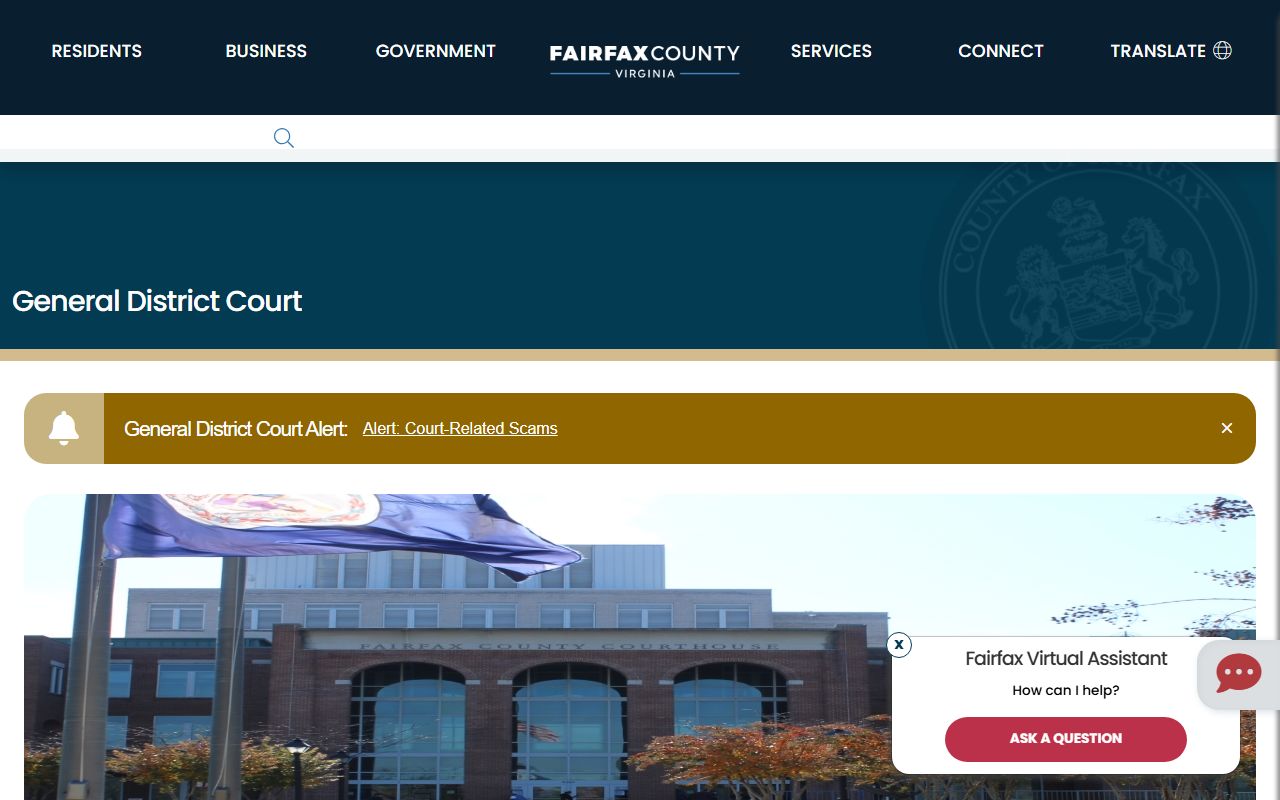
That state-court page lists the daily docket schedule and division contacts, which helps when you need to confirm a court date before a hearing.
Fairfax County Courthouses
Most court records work happens at one large complex. The Fairfax County Courthouse, also called the Judicial Center, sits at 4110 Chain Bridge Road in Fairfax. The Circuit Court, General District Court, JDR Court, Public Law Library, and the records offices all operate there. The Adult Detention Center and the offsite records center are nearby but at their own addresses. Plan your visit around the right building and suite.
Fairfax County Courthouse
4110 Chain Bridge Road
Fairfax, VA 22030
703-691-7320
Offsite Records Center
2730 Prosperity Avenue, Suite 100
Merrifield, VA 22031
703-246-6656
Adult Detention Center
10520 Judicial Drive
Fairfax, VA 22030
703-246-2100
Types of Court Records Available in Fairfax County
Fairfax County court records cover a wide range of case types. Civil and criminal Circuit Court files are the largest group, but district court records, family files, and probate matters all carry their own rules. The court that hears a case is usually the court that keeps the record. That is why a traffic ticket and a felony do not show up in the same search.
Here is a quick look at the main record types and where they live.
- Criminal records - felony files in Circuit Court, plus misdemeanor and arrest-related records detailed on the Fairfax County arrest records page.
- Civil records - complaints, judgments, and orders in Circuit and General District courts.
- Family and divorce records - divorce is filed in Circuit Court; custody and support often start in JDR, as covered under marriage and divorce records.
- Probate records - wills, estates, and guardianships handled by the Circuit Court Clerk, shown on the probate records page.
- Traffic records - infractions and citations heard in the General District Court Traffic Division.
The JDR Court explains its juvenile and domestic role on the official JDR District Court overview.
Because JDR files are mostly confidential, that page also makes clear that many juvenile and family records are not open to general public search.
What Fairfax County Court Records Show
A case record is more than a name and a date. The public index in eCaseSearch lets you search by case type, party name, or case number. Civil cases often carry a CL prefix, while criminal cases use codes such as FE for felony and MI for misdemeanor. Once you open a case, you can read the parties, the filing date, the status, and the docket activity. Documents themselves are not part of the free index.
| Field | What It Shows |
|---|---|
| Case Number | The court's unique ID, often with a type code like CL, FE, or MI. |
| Filing Date | The date the case began or a document was filed. |
| Parties | Plaintiff and defendant, or the Commonwealth and a defendant in a criminal case. |
| Charges / Cause | The charge in a criminal case or the claim in a civil suit. |
| Disposition | The outcome, such as guilty, dismissed, or judgment entered. |
| Sentence / Judgment | The penalty or money award ordered by the court. |
For a deeper field-by-field walkthrough, see the Fairfax County court records page.
Public Access Laws for Fairfax County Court Records
Court records in Virginia have their own access rules. They are not handled like an ordinary county FOIA request. Fairfax Circuit Court notes that records kept by clerks of courts of record are open under Title 17.1, so the right path is the clerk, the online systems, or a copy request. The rules below shape what you can see and how.
Key Statutes:
Virginia Code § 17.1-208 - makes most court records in clerks' offices open for public inspection and copying.
Virginia Code § 2.2-3700 - sets the state FOIA policy that public records are presumed open unless an exemption applies.
Virginia Code § 17.1-293 - limits how Social Security numbers and other personal identifiers can be posted or shown online.
The Fairfax County public records page explains the FOIA-versus-court-records line in more detail.
Records That Are Restricted or Confidential
Not every file is open. Several record types stay private by law or by court order. Adoption files are sealed because of their sensitive nature, and inactive adoption files need a court order to view. Juvenile and JDR records are confidential under Virginia Code § 16.1-305. Sealed and expunged criminal cases do not appear in the public index.
To view a sealed record, you usually need a court order or a clear statutory right. The process runs through the court that controls the file, not through a general records desk. Marriage licenses issued from July 1, 1997 through June 30, 2001 carry special limits because Social Security data was not blocked at the time. Either spouse can still get a copy with valid photo ID.
Specialty Courts in Fairfax County
Fairfax runs several treatment-focused dockets tied to its Diversion First effort, which began January 1, 2016. The Veterans Treatment Docket serves justice-involved veterans dealing with addiction or mental illness. Fairfax was the first jurisdiction in Virginia to organize this kind of program, and its first formal session was February 12, 2015. The docket addresses PTSD, traumatic brain injury, substance abuse, and related needs.
The Mental Health Docket started in 2018 and has connected more than 150 people with services. Recovery Court, sometimes called Drug Treatment Court, offers an alternative path for certain non-violent charges so graduates can avoid a lasting record. The Office of the Commonwealth's Attorney lists these dockets and their coordinators.
The prosecutor's office describes each program on its specialty treatment dockets page.
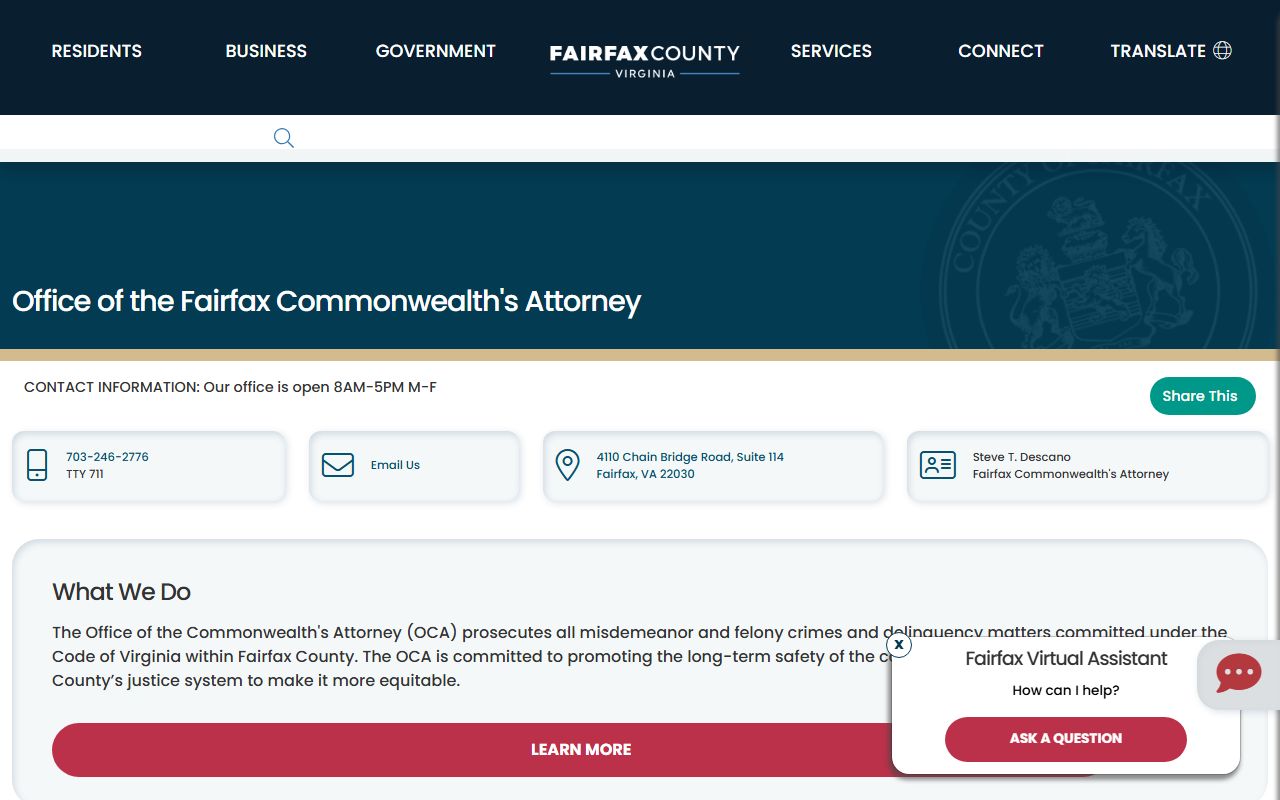
Diversion First connects police, judges, magistrates, the public defender, and behavioral-health providers to steer eligible people away from jail when possible.
Fairfax County Sheriff and Jail
The Fairfax County Sheriff's Office runs the Adult Detention Center, or ADC. Sheriff Stacey A. Kincaid leads the office. The jail sits at 10520 Judicial Drive, next to the courthouse, and its main line is 703-246-2100. There is no public online jail roster on the official Sheriff site, so inmate lookups go through the ADC phone tree and Virginia VINE. The jail's rated capacity is 1,260.
For the full custody search steps, see the Fairfax County inmate records page, and for active warrant guidance see warrant records. You can also review jail counts on the jail population page.
The Sheriff posts visitation, mail, and money rules across its official site, starting at the Sheriff's Office home page.
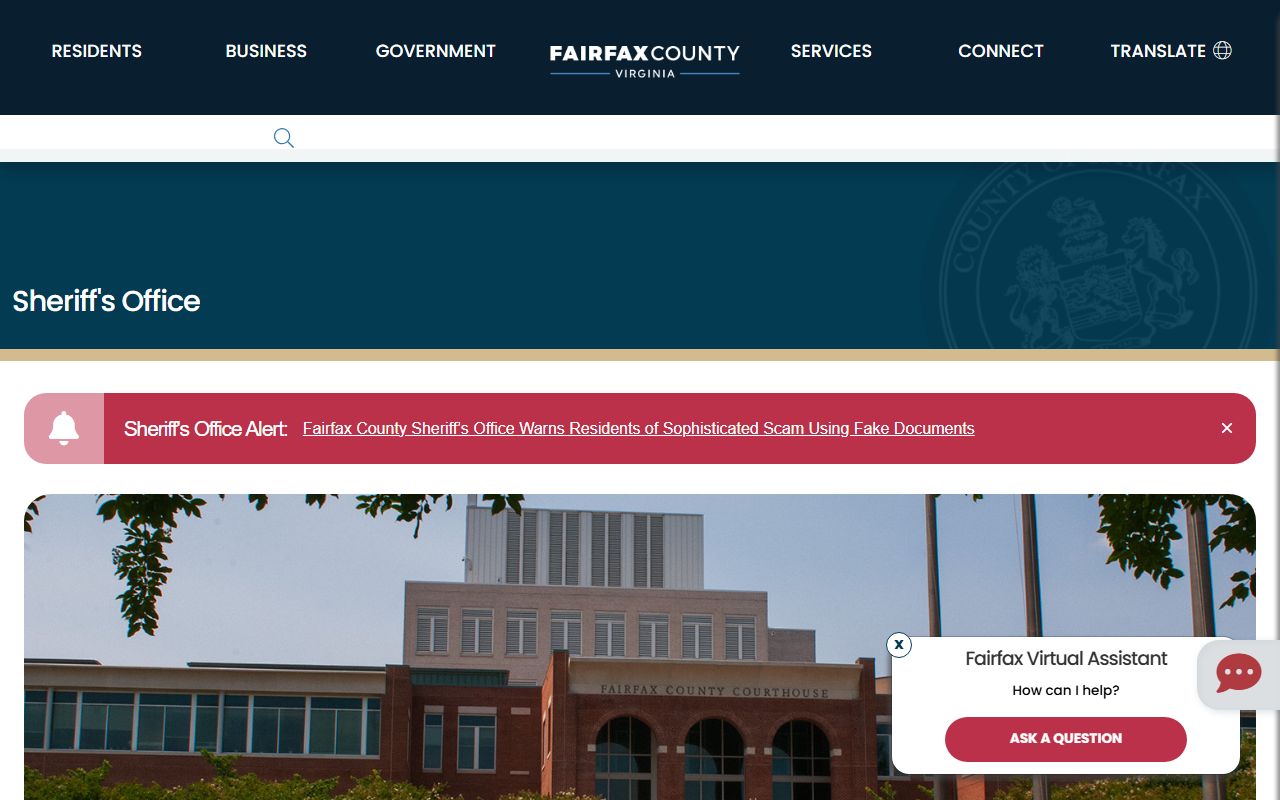
Because personal mail now routes through a third-party vendor, that site is the best place to confirm current inmate contact rules before you send anything.
Marriage, Divorce, and Probate Records
The Circuit Court Clerk issues marriage licenses and keeps divorce and probate files. There is no Virginia residency rule for a marriage license, but a divorce does require six months of state residency before filing. Probate runs through the clerk's probate and fiduciary function rather than a separate probate court. See marriage and divorce records and probate records for full steps and fees.
- Testator
- A person who makes a will.
- Executor
- The person named in a will to carry out the estate.
- Conservator
- A person appointed to manage the finances of someone who cannot.
Fairfax County Court Records Fees
Fees depend on the record and the office. The Clerk of the Circuit Court sets copy and service fees, and many are small and flat. A credit card adds a 4% processing fee in most cases. Civil filing fees vary by case and statute. The table below lists common public fees pulled from the court's published schedules.
| Item | Amount |
|---|---|
| Marriage license | $30.00 |
| Certified marriage-license copy | $2.50 per copy |
| Land record certified copy | $2.00 per document + $0.50 per page |
| Public Law Library copy | $0.25 per side |
| Credit card convenience fee | 4% |
The court's full fee landing page is published on the Circuit Court fees page.
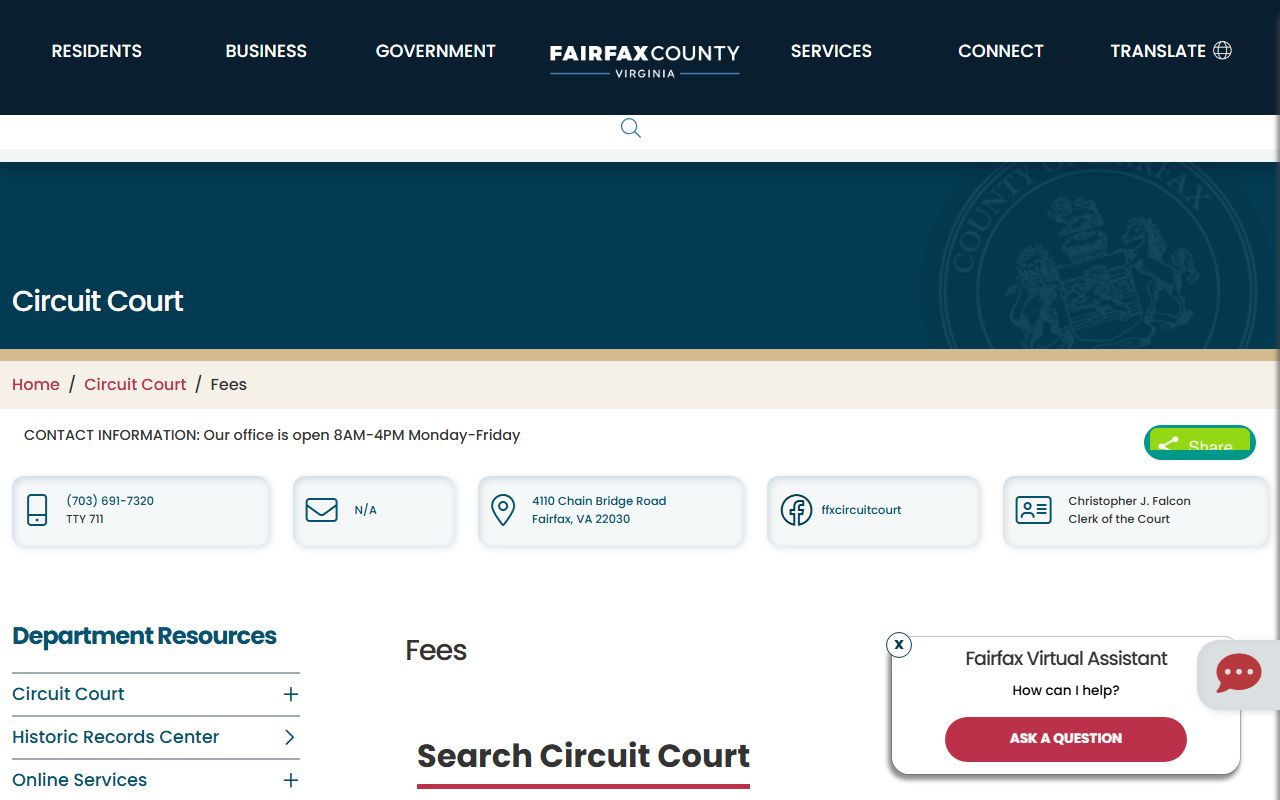
Civil filing instructions and the current fee schedule, effective July 1, 2025, are linked from that same page.
How to Interpret Fairfax County Court Records
Court files use shorthand. A charge is not the same as a conviction, and an arrest is not proof of guilt. A docket may read "nolle prosequi," which means the prosecutor dropped the charge. "Dismissed with prejudice" means the case cannot be refiled. A "continuance" is just a delay. Case status terms like pending, closed, or appealed tell you where the case stands. When a code is unclear, the clerk can explain the procedure, though staff cannot give legal advice.
Accuracy and Record Limitations
Online data can lag behind the paper file. The public index updates often, but a recent filing or order may not appear right away. Sealed and expunged cases are removed from public view. If a record looks wrong, contact the court that holds it.
Note: Always confirm case details with the originating clerk's office before you rely on an online Fairfax County court record for any legal or financial decision.
History of Fairfax County Courts
Fairfax County has deep court roots. The historic courthouse was finished in 1800 and was the county's third courthouse. The first stood near Tysons around 1742, and the court moved to Alexandria in 1752 before returning to the Fairfax site. Circuit Court met in the historic building until the Judicial Center opened in the 1980s. The Historic Records Center still holds deed books from 1742 to 1942. Some early order books from 1775 to 1783 are missing and were likely burned or stolen during the Civil War. In a modern leap, the court launched eCaseSearch on July 1, 2024.
Frequently Asked Questions
How do I search Fairfax Circuit Court records online?
Use Fairfax eCaseSearch. Choose Civil or Criminal, then search by party name or case number. Name searches need at least the first two letters of the last or company name. The system is free, but it is an index only. Documents and sealed cases are not provided.
Why is Fairfax missing from the statewide circuit case system?
Fairfax Circuit Court does not use the statewide Circuit Case Management System and does not take part in that online case search. For Fairfax Circuit cases, use eCaseSearch or call the court at 703-246-4111. A statewide search alone can wrongly suggest no Fairfax case exists.
Where do I search Fairfax traffic or misdemeanor cases?
Use the Virginia General District Court Online Case Information system. Select Fairfax County General District Court or Fairfax City General District Court based on your summons. With a full case number, you can search that case directly. More detail is on the traffic court records page.
Does Fairfax have an online jail roster?
No public online jail roster was found on the official Sheriff site. Call the ADC at 703-246-2100, press 4 for confinement, then 1 for inmate information or 2 for bonds and release dates. Virginia VINE handles custody notifications. See the inmate records page.
More answers are on the Fairfax County Court Records FAQ page.