
How to Find Fairfax County Arrest Records
The Fairfax County Sheriff's Office runs the Adult Detention Center but does not publish a public online arrest blotter or jail roster. To check on a recent arrest, you call the ADC inmate information line. Dial 703-246-2100, press 4 for confinement, then 1 for inmate information or 2 for bonds, release dates, and court dates. For custody alerts, Virginia VINE sends notifications. Once charges are filed, the case moves into the court system.
After booking, an arrested person sees a magistrate for an initial bail decision, then appears in court. The full custody steps are on the Fairfax County inmate records page. To follow the criminal case itself, use the court systems described on the court records page.
So a complete arrest lookup often takes two paths. One path is the jail, for booking and custody. The other path is the court, for the charge, the hearing, and the outcome.
Arrest Record vs Criminal Court Record
These two records are not the same. An arrest record reflects a police action and jail booking. A criminal court record reflects what the court did with the charge. One can exist without the other, and they live in different places.
| Feature | Arrest Record | Criminal Court Record |
|---|---|---|
| Created by | Police and the Sheriff's jail | The court that hears the case |
| Shows | Booking, charge at arrest, custody status | Charges, plea, disposition, sentence |
| Where to look | ADC inmate line, VINE | eCaseSearch, General District case system |
| Proves guilt? | No | Only a conviction does |
For the full criminal case history, the court file is the better source. Use the Fairfax County court records page for those searches.
Where Arrest and Booking Information Comes From
Booking happens at the Adult Detention Center at 10520 Judicial Drive, next to the courthouse. Staff process the arrest, screen the person medically, and classify them for housing. The Sheriff's Office is fully certified by the Virginia Department of Corrections to run the jail. There is no public booking form online, so the phone tree and VINE remain the official routes.
Felony cases are handled in Circuit Court, while misdemeanors and traffic offenses are handled in the General District Court. A felony usually starts with a preliminary hearing in the district court, then moves up by indictment. That is why an arrest can show up in one court at first and a different court later.
Charges vs Convictions in Fairfax County
The wording on a record matters. A charge is an accusation. A conviction is a finding or plea of guilt. Reading a charge as a conviction is a common and serious mistake.
| Term | What It Means |
|---|---|
| Charge | The offense a person is accused of at arrest or by indictment. |
| Nolle prosequi | The prosecutor chose not to go forward with the charge. |
| Dismissed | The court ended the charge without a conviction. |
| Conviction | A guilty plea or a finding of guilt by the court. |
A criminal court record shows the disposition, which is the field that tells you the real outcome.
Mugshots and What Is Public
Fairfax County does not run a public mugshot gallery on its official Sheriff pages. Booking photos are not posted for open public browsing the way some other places post them. That is why third-party mugshot sites should not be treated as official. Those sites often hold old or wrong data and are not court records.
Public access to criminal information here runs through the court case systems and the jail's official phone and notification tools. If a person is in state prison rather than the county jail, the state corrections locator applies. Federal custody uses the federal locator instead.
Sealing and Expungement of Fairfax County Records
Virginia law lets some records be removed from ordinary public access. The two main paths are expungement and sealing, and they are not identical.
| Feature | Sealed | Expunged |
|---|---|---|
| Effect | Restricts public online and general access | Removes eligible records to a sealed file |
| Typical use | Newer sealing pathways for eligible offenses | Acquittals, dismissals, nolle prosequi |
| Where filed | Circuit Court | Circuit Court |
| Public index | Not shown in eCaseSearch | Not shown in eCaseSearch |
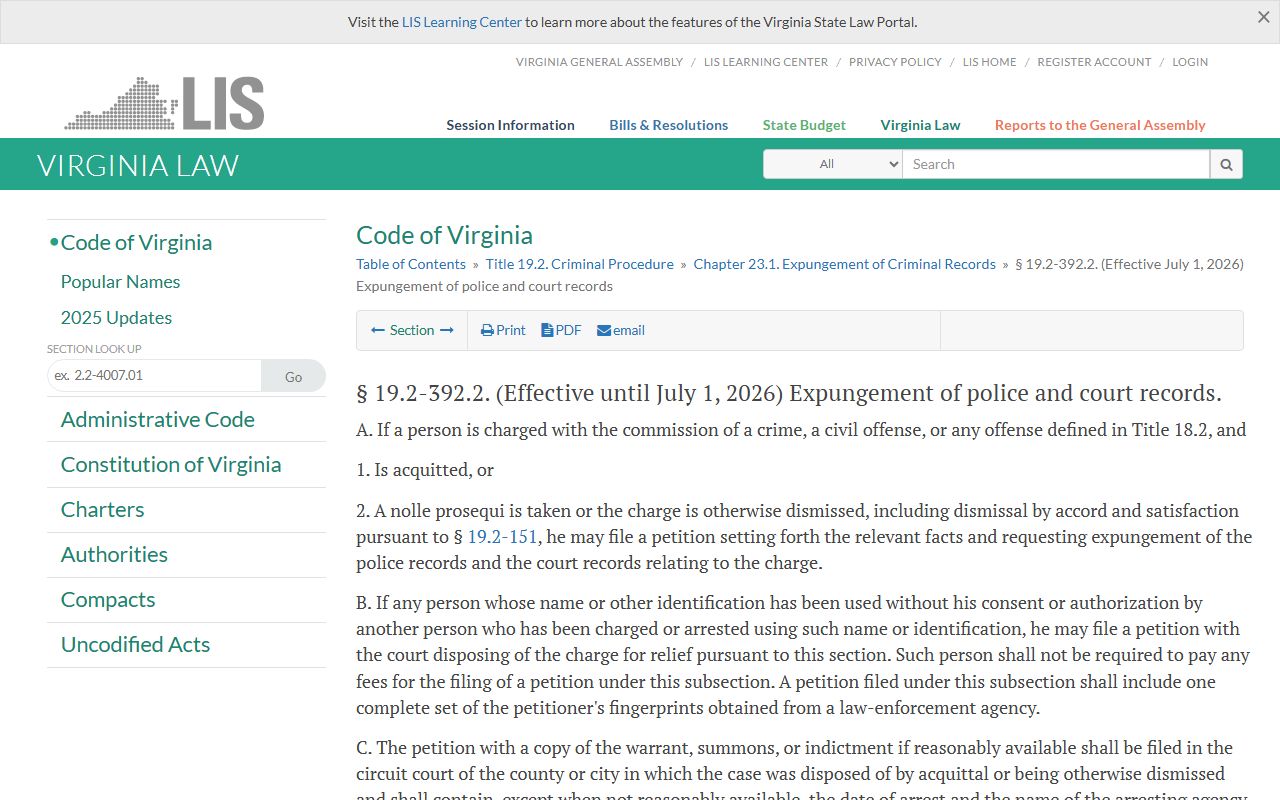
Expungement is governed by Virginia Code § 19.2-392.2. A petitioner files in Circuit Court, serves the Commonwealth's Attorney, and often gives fingerprints so state police can match the record. The petition is held under seal unless the court orders otherwise.
The expungement statute itself sets out who qualifies and how the process works.
Newer sealing rules add more pathways for certain offenses and nonconvictions.
Those sealing provisions sit in their own chapter of the state code, shown below.
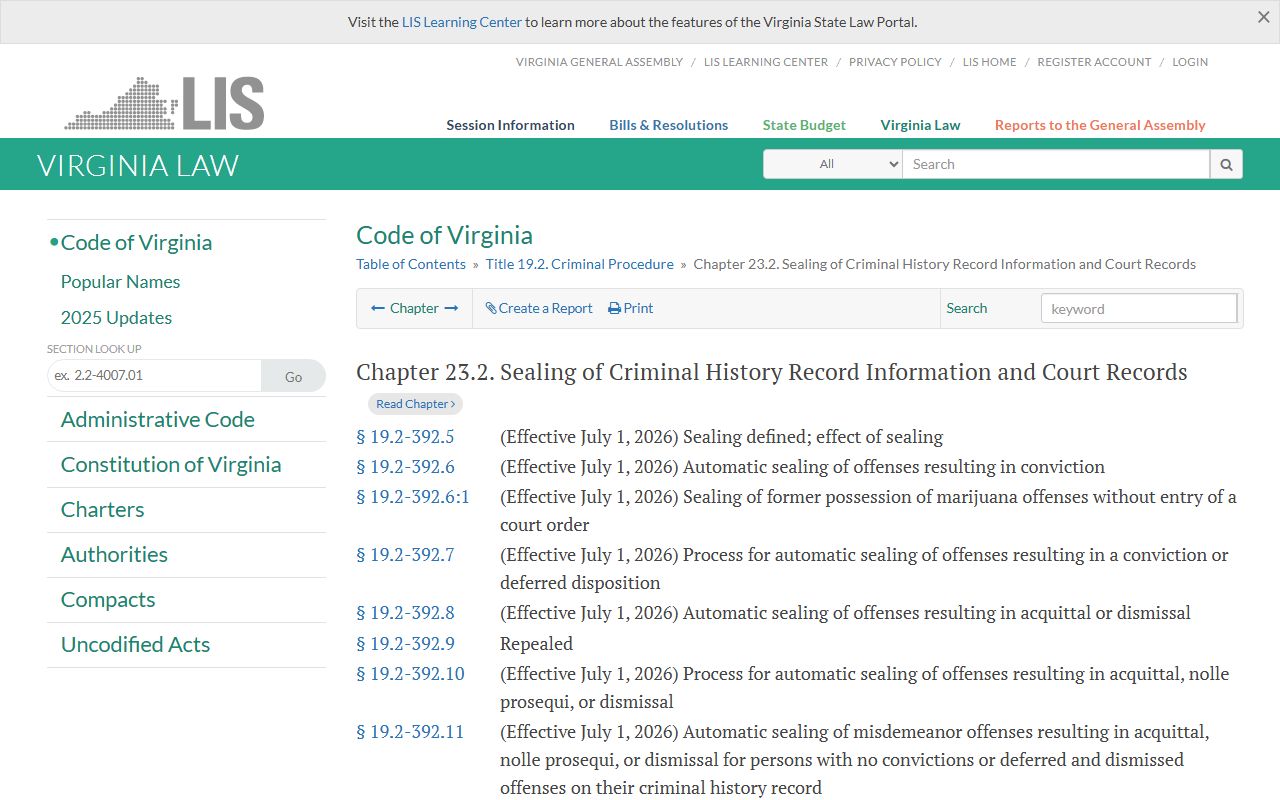
Details depend on effective dates and offense type, so the current statute should always be checked. The sealing chapter of Title 19.2 controls those eligible offenses.
Criminal History and Background Checks
A single Fairfax County arrest record is not a full criminal history. A statewide criminal-history check is kept at the state level and pulls from many courts and agencies, not just one county file. That is why an arrest in Fairfax may not tell the whole story, and why a court disposition matters so much.
Arrest-only entries and dismissed charges can linger in some databases until a record is sealed or expunged. For any decision tied to employment, housing, or credit, official court and state sources are the right path, and this private site cannot be used for those purposes. Sealed and expunged matters are removed from the public court index.
The Commonwealth's Attorney's Role
Virginia's local prosecutor is the Commonwealth's Attorney. In Fairfax, that office is led by Steve T. Descano and sits at 4110 Chain Bridge Road, Suite 114. The office prosecutes misdemeanors, felonies, and delinquency matters under the Code of Virginia within the county. It also runs diversion programs and specialty treatment dockets.
The prosecutor decides whether and how to pursue a charge. That choice shapes the court record, including a possible nolle prosequi or a reduced charge. The office can be reached at 703-246-2776.
Public Defender and Appointed Counsel
People who cannot afford a lawyer may get a public defender or a court-appointed attorney if eligible. The Virginia Indigent Defense Commission runs public defender offices statewide and certifies court-appointed counsel. A Fairfax Public Defender office serves the local courts. These attorneys handle trial and appeal work in the General District, JDR, and Circuit Courts.
The statewide office directory lists the Fairfax location.
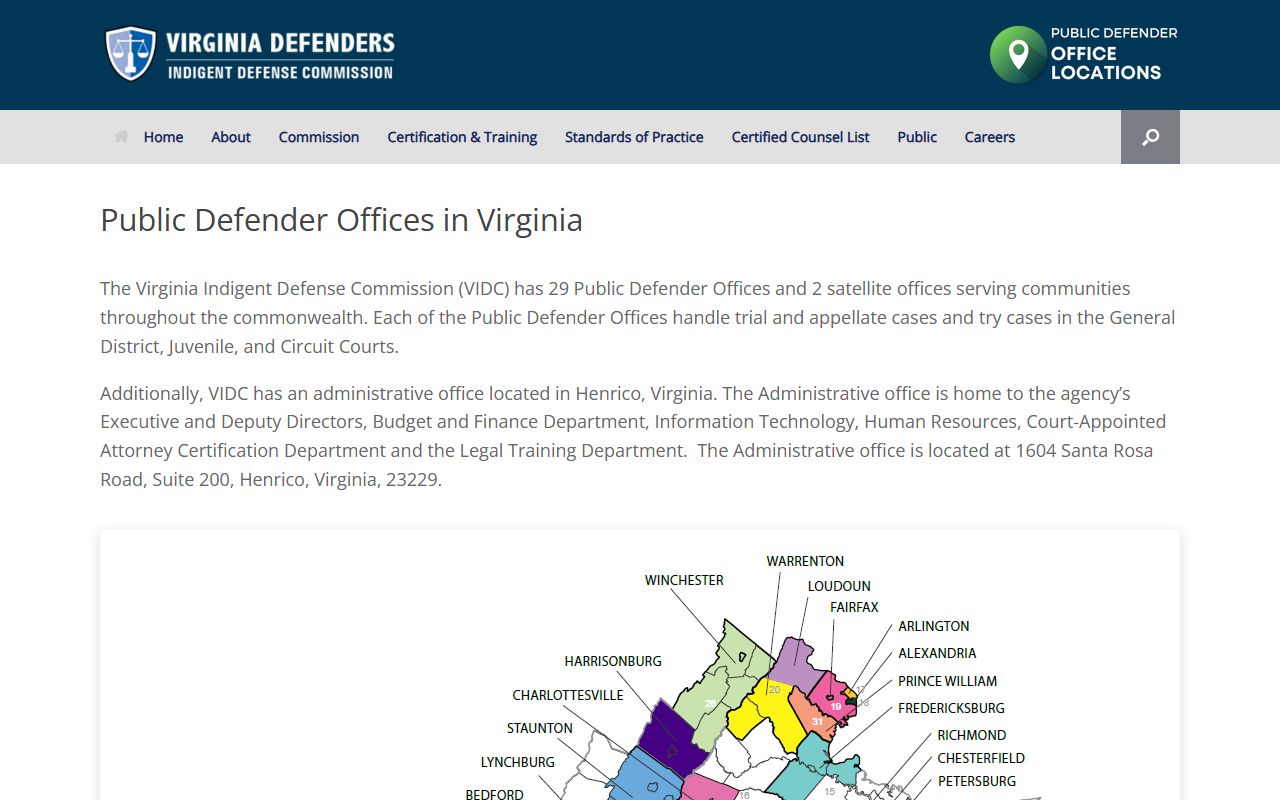
You can confirm the current Fairfax office card on the public defender office directory before you call.
Specialty Dockets and Diversion First
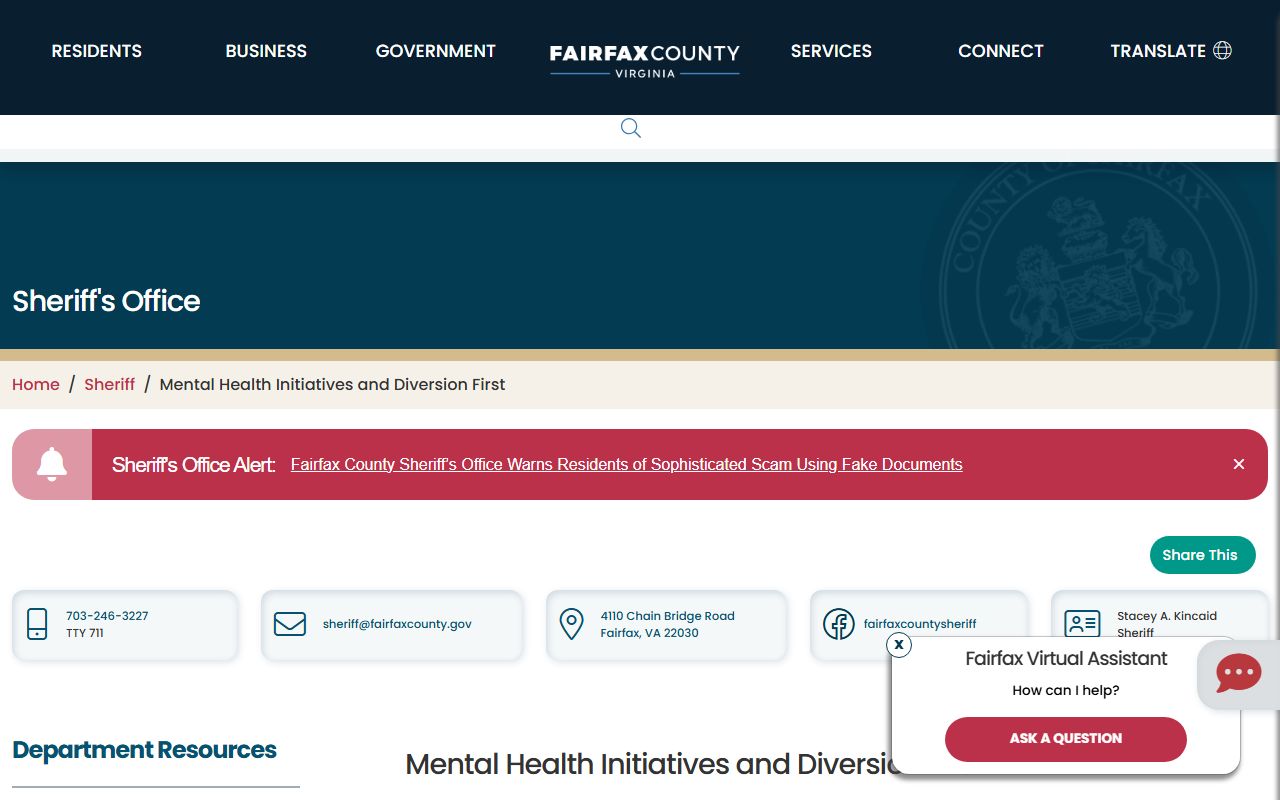
Fairfax leans on treatment over jail for many low-level cases. Diversion First began January 1, 2016 and connects police, courts, magistrates, the public defender, prosecutors, and behavioral-health providers. The county reports more than 4,400 diversions from potential arrest since 2016 and a 26% drop in the jail behavioral-health population with misdemeanor charges from 2015 to 2024.
The treatment dockets include the Veterans Treatment Docket, the Mental Health Docket, and Recovery Court. The Sheriff describes the mental-health and diversion side of this work.
The Commonwealth's Attorney lists each treatment docket and its coordinator on a dedicated page.
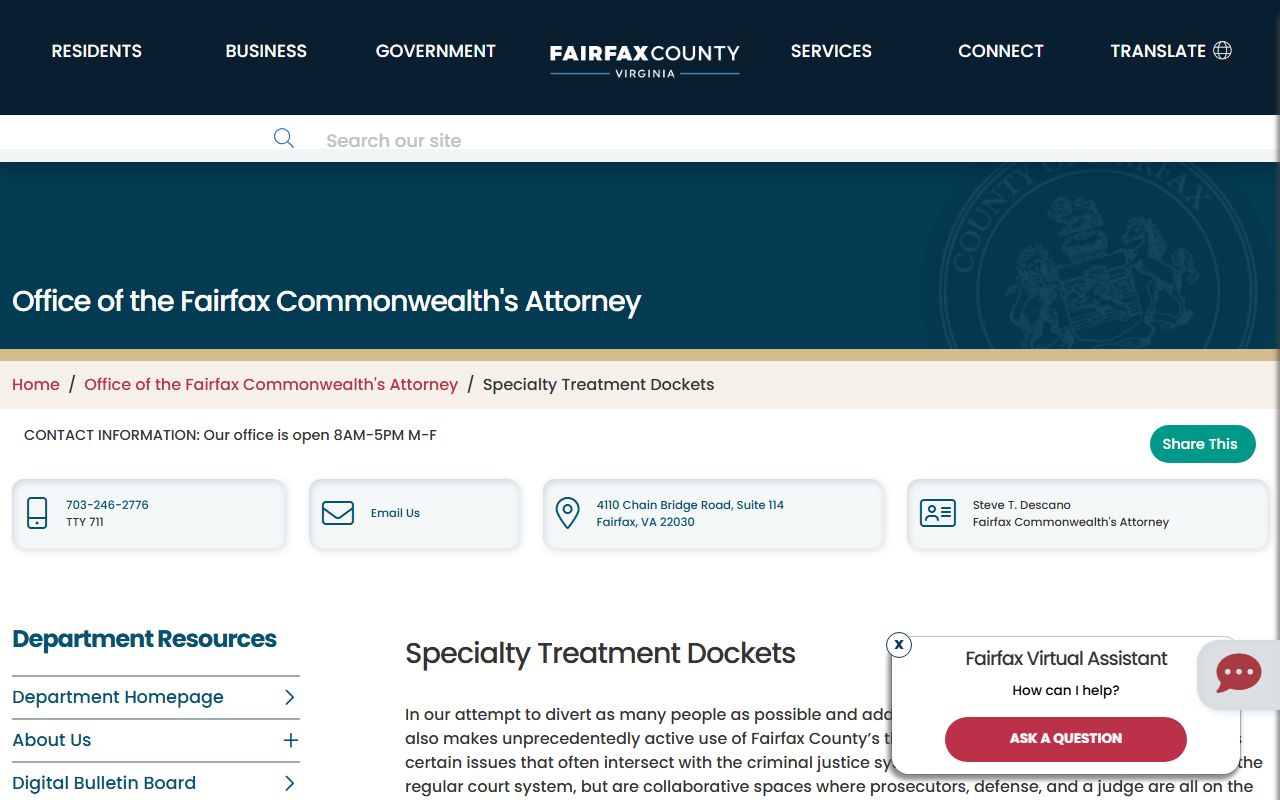
Those programs can change a case outcome and, in some pre-conviction tracks, help a graduate avoid a lasting criminal record. The specialty treatment dockets page has current contacts. DUI and other criminal traffic charges are handled as criminal cases, covered on the traffic court records page, and active warrants are explained on the warrant records page.