
How to Search Fairfax County Traffic Court Records
Traffic cases are not in the Circuit Court index. They sit in the Virginia General District Court Online Case Information system, reached from the state Judicial System case page. Select Fairfax County General District Court, or Fairfax City, Vienna, or Herndon if the summons names one of those courts. With a full case number, you type the number and search.
The official portal was rate-limited during research, so check current labels before you rely on a search. The Fairfax Traffic Division also documents the workflow.
| Field Label | Type | Required | Notes / Format |
|---|---|---|---|
| Court | Dropdown | Yes | Select Fairfax County General District Court. |
| Case number | Text | If known | Type the full case number and search. |
| Defendant name | Text | If number lost | Statewide search can find the jurisdiction. |
| Hearing date | Date | No | Refine the docket by date where supported. |
| Mark for Payment | Result button | Conditional | Appears only for prepayable cases. |
If a ticket does not show "Mark for Payment," the case may not be online-payable and may need a call or appearance.
Which Courts Handle Traffic Cases in Fairfax County
The Fairfax County General District Court Traffic Division hears most traffic cases for the county. The division sits at 4110 Chain Bridge Road, Room 106, and can be reached at 703-246-2815. A case may instead belong to Fairfax City, Vienna, or Herndon if the summons names that court, and a felony-level or appealed case can move to Circuit Court.
The Traffic Division page lists topics, forms, and the DMV points explanation.
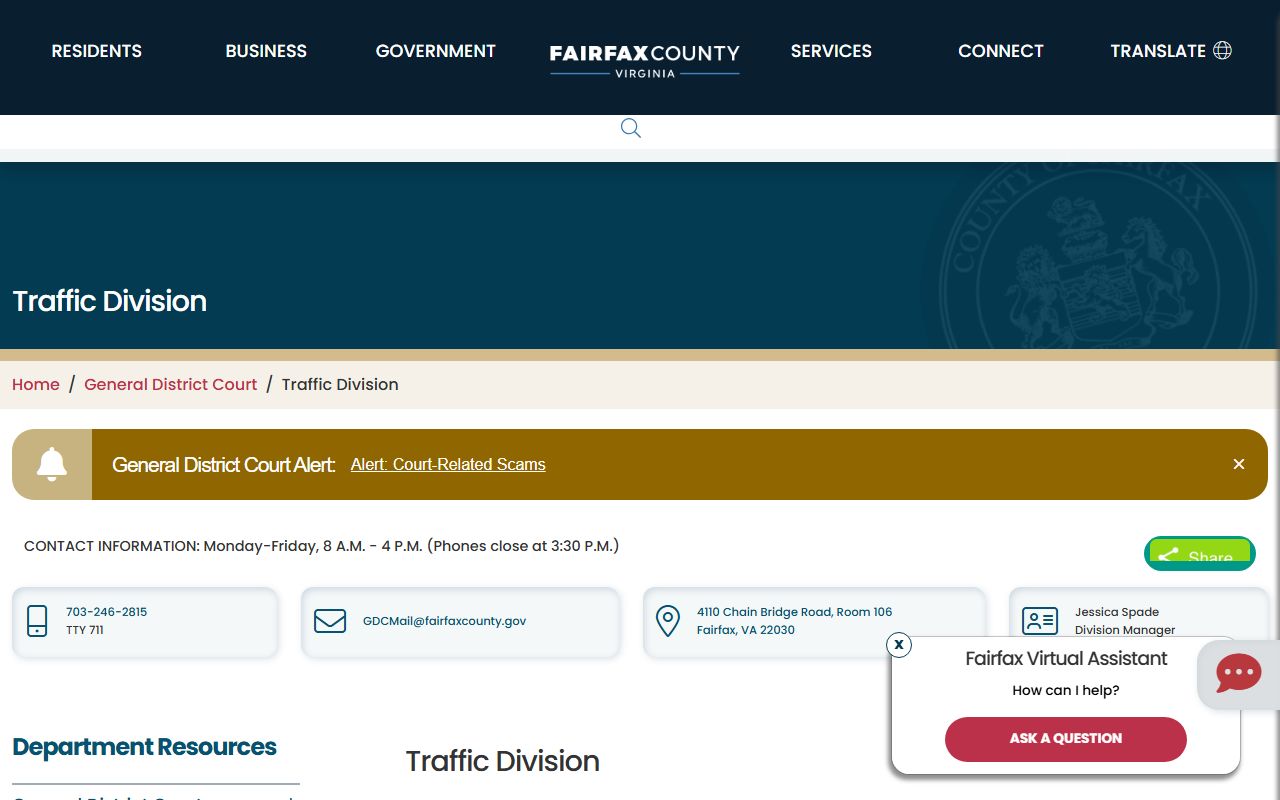
The official Traffic Division page covers appeals, continuances, payment plans, restricted licenses, and more.
Types of Traffic Cases on Record
Traffic records cover more than speeding. Most offenses are traffic infractions, which carry a fine. Others are criminal traffic offenses that can mean jail or a license loss. Fairfax also runs locally specific dockets.
- Moving violations like speeding and improper passing.
- Non-moving and equipment violations.
- Toll road, HOT lane, VDOT, and I-66 cases.
- Criminal traffic offenses such as DUI and reckless driving.
- Parking matters, which follow a separate hearing track.
Each type can carry different rules for payment, appearance, and DMV impact.
What Fairfax County Traffic Court Records Show
A traffic court record holds the case details, not your full driving history. The table below shows the common fields you will see.
| Field | What It Shows |
|---|---|
| Court case number | The ID for the citation in the court system. |
| Court name | Which court holds the case, such as Fairfax County GDC. |
| Charge / offense | The cited violation or offense description. |
| Hearing date / time | When the case is set and whether you must appear. |
| Disposition | Paid, guilty, dismissed, amended, or continued. |
| Fine and court costs | Amount owed to the court, separate from DMV points. |
The record may also note the officer or agency and whether the conviction is reported to the DMV.
Searching by Citation Number vs by Name
You can search two ways, and the better choice depends on what you have. A case number gives the fastest, cleanest result and ties straight to one case. A name search helps when the summons is lost or you do not know the court.
If you do not know the jurisdiction, the statewide Online Case Information search can find the case by name, but payments cannot be made from the statewide search. Once you find the case, switch to the correct court to pay or to read the docket. The Fairfax County court records page explains the wider case search.
Paying or Contesting a Fairfax County Traffic Ticket
Fines and costs can be paid by internet, mail, phone, or in person. Accepted methods are cash, check or money order, and major credit cards. Online payments go through the Supreme Court of Virginia website. Follow these steps.
- Read the summons for the court, date, charge, and whether you must appear.
- Search the GDC online system and select Fairfax County General District Court.
- If the case shows "Mark for Payment," prepay before 3:30 p.m. the business day before trial.
- If there is no "Mark for Payment," call 703-246-3764 or the Traffic Division.
- To contest, appear on the date or follow the steps for a trial, continuance, or motion.
- If payment is due after court, pay within 90 calendar days of the court date.
The state payment guidance explains the "Mark for Payment" option.
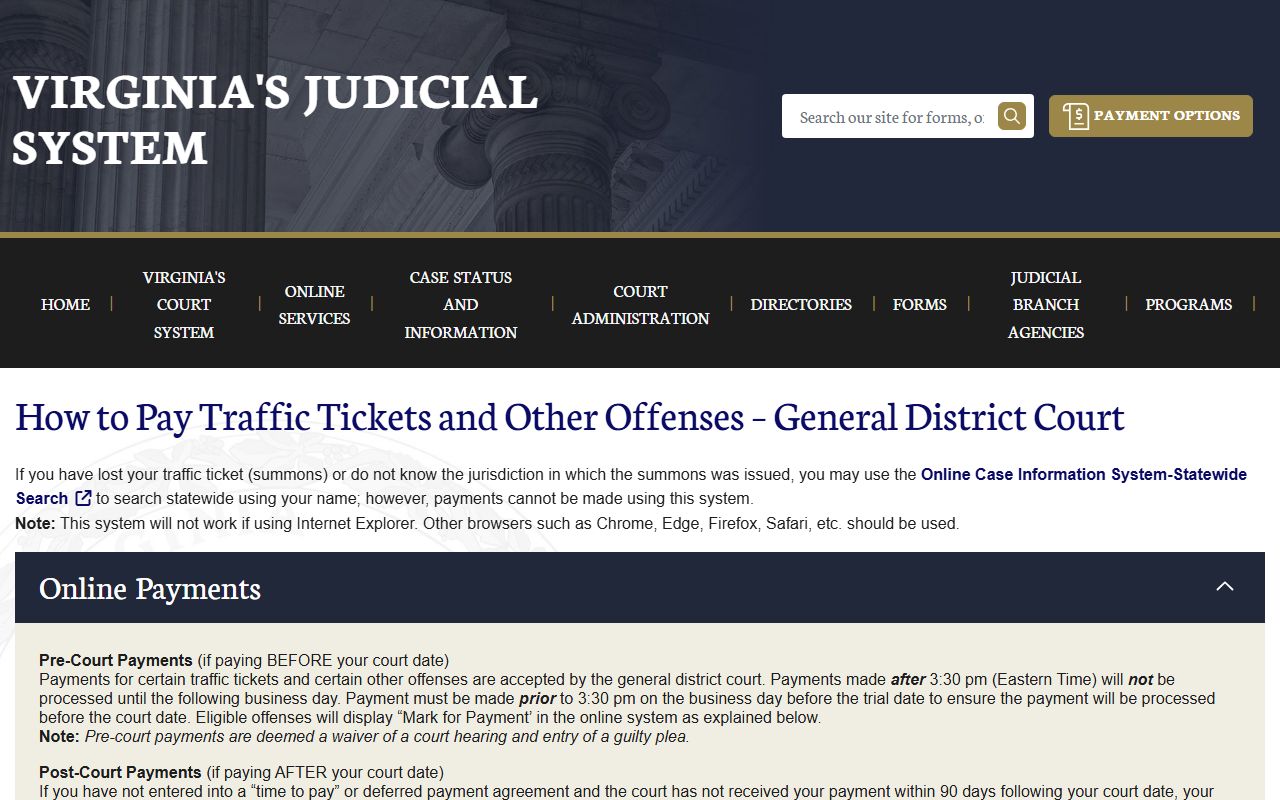
The state ticket payment instructions note that payments after 3:30 p.m. Eastern process the next business day.
Fairfax also hosts its own payment page for traffic and criminal fines and costs.
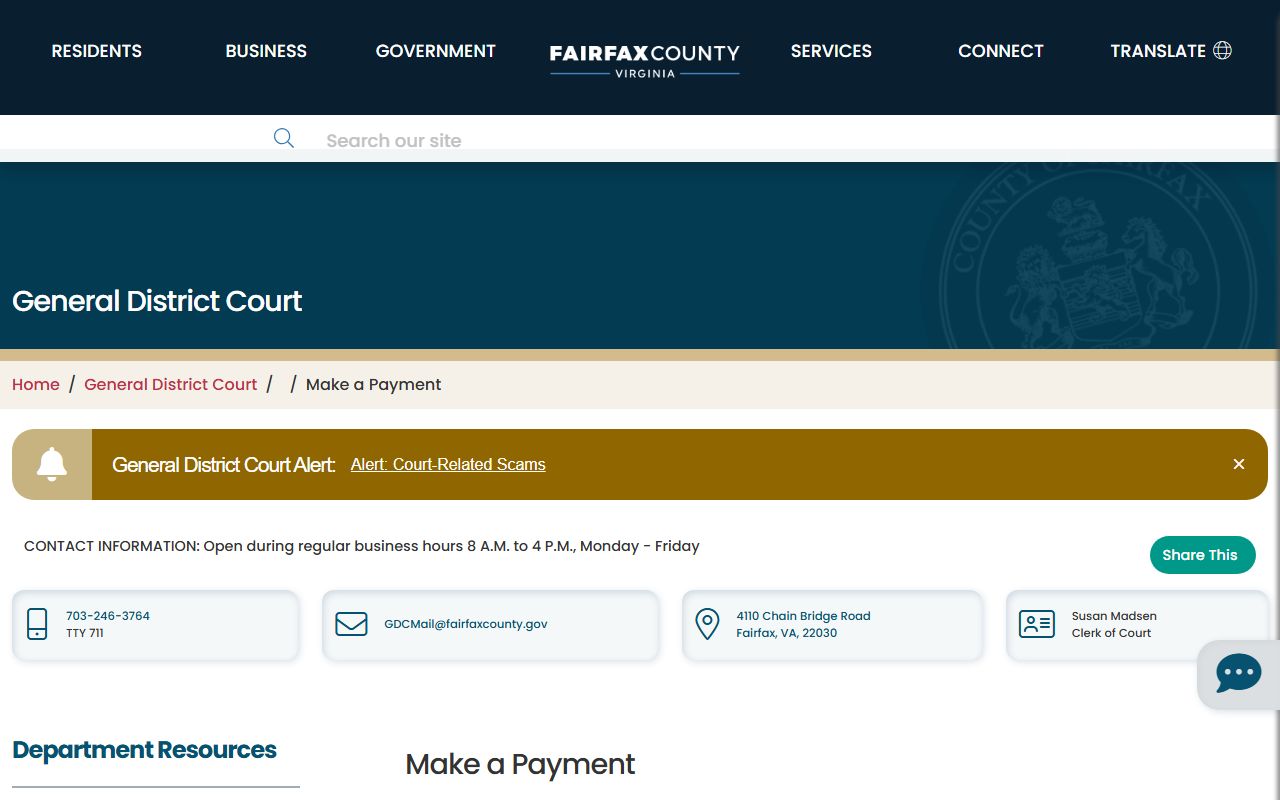
The Fairfax payment page says prepayment may waive the appearance and contest rights for that offense.
Public Access Laws for Traffic Court Records
Traffic court records are court records, so they are open under the same framework as other case files. Records kept by clerks of courts of record are inspectable under Virginia Code § 17.1-208, and the online case systems show case data.
A DMV driver record is different. It is held by the DMV under its own rules and is not an ordinary court record. So a court traffic record and a DMV record use separate access paths, which the next section explains.
Court Traffic Records vs State Driver Records
This is the single most useful distinction on the page. The court record and the DMV record answer different questions and live in different places.
| Feature | Court Traffic Record | DMV Driver Record |
|---|---|---|
| Maintained by | Fairfax General District Court | Virginia DMV |
| Purpose | Case, charge, hearing, disposition, fines | License status, points, suspensions, history |
| Search path | GDC Online Case Information; clerk | DMV record request transaction |
| Points | Conviction may trigger DMV points | DMV assesses and tracks points |
| Copy type | Court copy through the clerk | Official DMV transcript |
The DMV records landing page is the starting point for driver and vehicle records.
The Virginia DMV records page covers driver, vehicle, and related record services.
DMV Points Versus Court Fines
A court fine and a DMV point are not the same penalty. If you are convicted of certain violations, the DMV assesses demerit points as an administrative action in addition to any sentence a judge imposes. Paying the court fine closes the court debt, but it does not erase the conviction, the points, or any insurance effect.
Demerit points remain on the record for two years from the offense date, while a conviction stays for a longer period that depends on severity. Some serious convictions remain permanently.
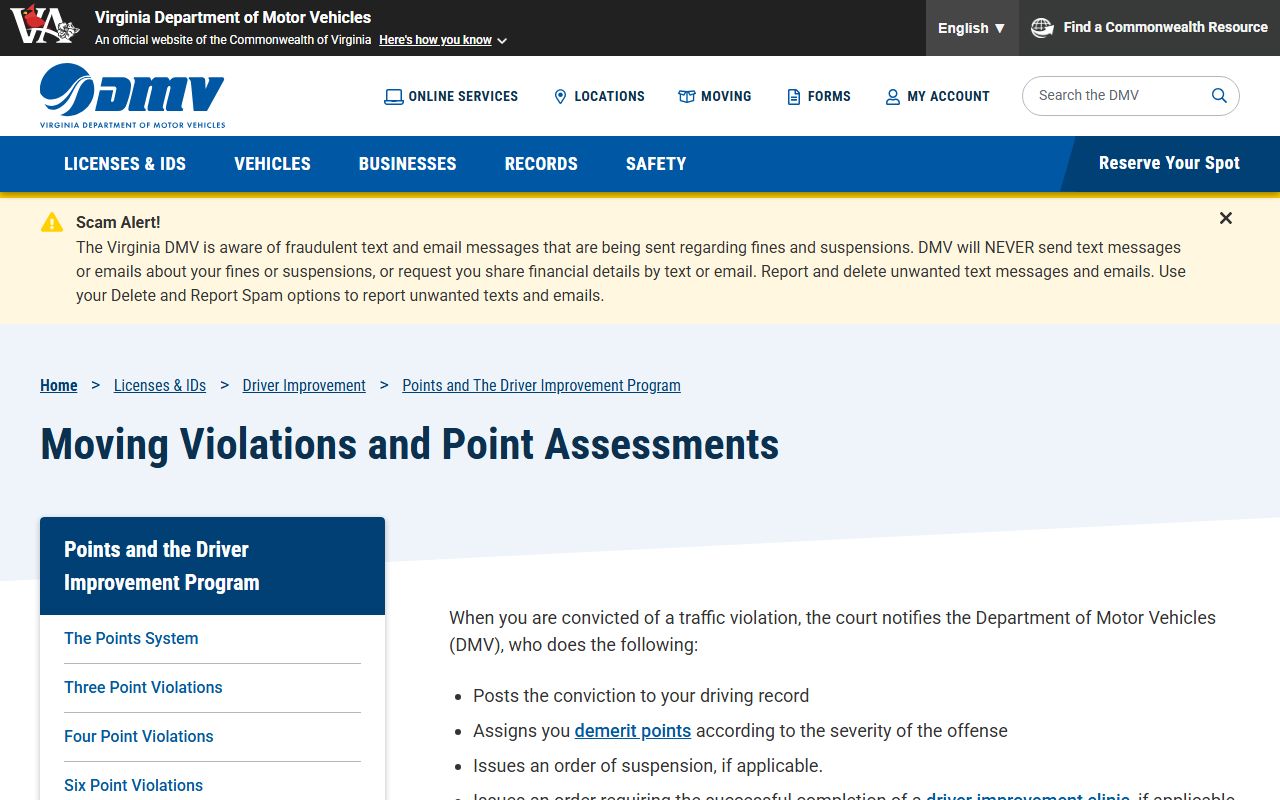
The DMV explains demerit points on its points assessment page.
Driver Records From Virginia DMV
You can order an official copy of your driver record or a vehicle record you own from the DMV. The transaction requires DMV login and identity verification. A record viewed online can be viewed again within five days of purchase at no charge, and a mailed record is sent within five business days.
The DMV record request transaction handles the order.
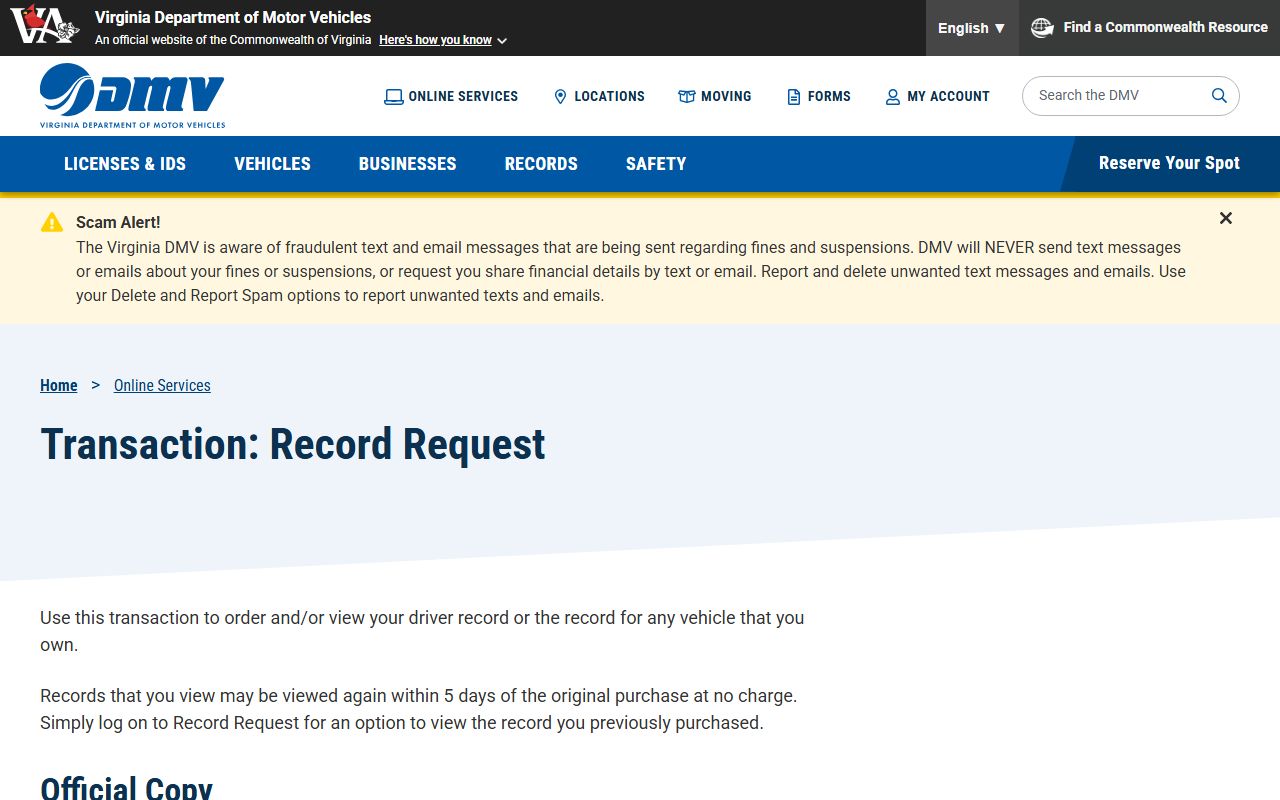
The DMV record request page lets you view or order a driver or vehicle record.
CDL and Commercial Driver Records
Commercial drivers face stricter rules. Some traffic convictions carry consequences beyond ordinary demerit points for a CDL holder. The official Fairfax source set does not publish a separate CDL rule page, so commercial drivers should check the DMV and federal CDL rules directly.
Out-of-state drivers can still face Virginia court fines and costs, plus home-state reporting through interstate driver systems. Using the DMV and court official sources is safer than relying on general national claims.
DUI and DWI Cases
DUI and reckless driving are not ordinary payable tickets. These are criminal traffic matters that usually require a court appearance and can carry jail time and license loss. They are not prepayable like a simple infraction.
Because they are handled as criminal cases, the arrest and prosecution side is on the Fairfax County arrest records page. A person charged with DUI should consider counsel rather than treating it as a fine to pay.
Deferred Adjudication and Defensive Driving
The Traffic Division lists options that can affect a case outcome. A driver-improvement or defensive-driving course may be relevant in some cases, and the court lists payment plans and a Fine Options Program among its topics. A restricted license uses a separate application, the DC-263 form.
These options vary by case and judge, so the Traffic Division or an attorney can explain whether one applies. Missing a court date is listed as a major topic, and it can trigger added fines or a capias, covered on the warrant records page.
Sealing or Expunging Traffic Records
Some traffic-related matters may qualify for sealing or expungement, but the rules are narrow and depend on the disposition and offense. Expungement traditionally applies where a charge was dismissed, nolle prosequied, or ended in acquittal in qualifying circumstances.
A petition is filed in the Circuit Court. Because eligibility is specific, the full sealing and expungement process is explained on the arrest records page. Removing a conviction is different from clearing DMV points, which follow their own retention schedule.
Fees for Traffic Record Copies
Costs depend on what you owe and what you request. Court fines and costs are set by the offense and the court. Record copies follow the clerk or DMV schedule. The table below shows what drives each cost.
| Item | Basis |
|---|---|
| Court fine and costs | Set by the offense and the court. |
| Court record copy | Per the clerk's copy schedule. |
| DMV driver record | DMV transaction fee with identity verification. |
| Credit card convenience fee | 4% on eligible court payments. |
Parking tickets follow a separate track. To contest one, a person must request a hearing before the General District Court within 21 days of the ticket date, and added fees can apply if it escalates.